Khan Sir Controversy 2026: From Viral Controversies to Courtrooms: The Legal Consequences of Online Statements, Protests and Public Reactions
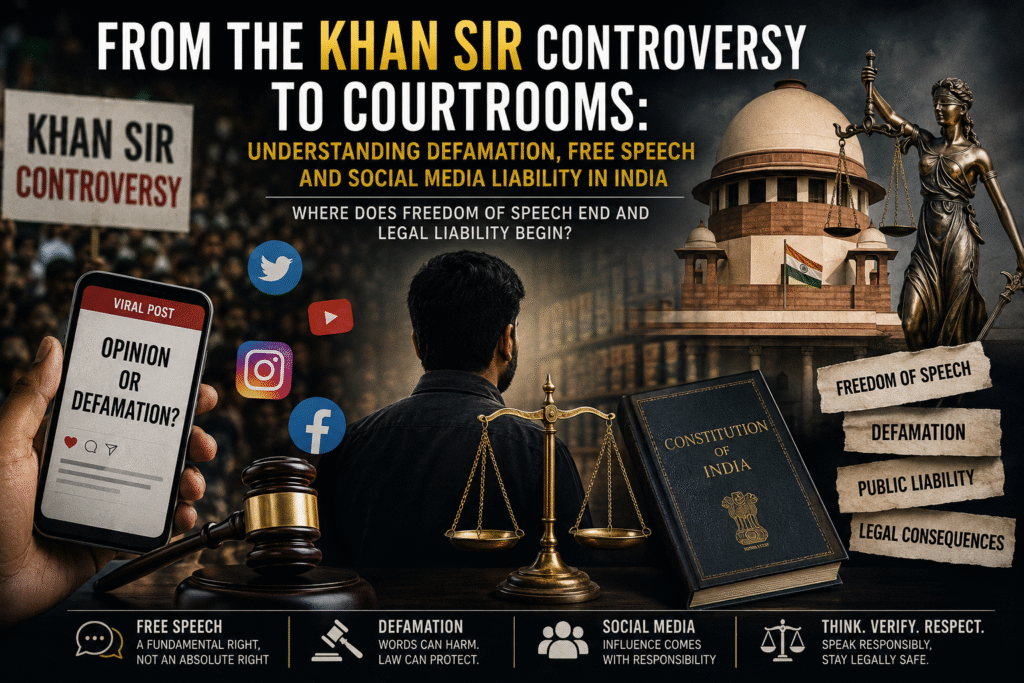
In today’s digital world, information travels faster than ever before. A statement made during a television debate, a tweet posted in frustration, an Instagram reel expressing an opinion, or a YouTube video criticizing a public figure can reach millions of people within minutes. Social media has democratized communication, allowing ordinary citizens to participate in discussions that were once dominated by traditional media houses and public institutions. However, with this unprecedented power comes an equally significant responsibility. Khan Sir
In recent years, India has witnessed numerous controversies where social media discussions have escalated into legal disputes. Public figures, journalists, educators, influencers, businesses, and even ordinary citizens have found themselves facing legal notices, defamation suits, police complaints, and criminal investigations arising out of statements made online. In many cases, what begins as a disagreement of opinions transforms into allegations of defamation, harassment, misinformation, incitement, or damage to reputation. Khan Sir
The rise of digital platforms has blurred the distinction between private speech and public speech. A comment posted from a personal account may be viewed by thousands or even millions of people. Consequently, courts and law enforcement agencies increasingly find themselves addressing disputes that originate in the online world but have real-world consequences. Khan Sir
This raises an important legal question: Where does freedom of speech end, and where does legal liability begin? Khan Sir
The answer lies in understanding the legal framework governing free expression, defamation, public order, and online conduct in India. Khan Sir
Freedom of Speech: A Fundamental Right Under the Constitution
The Constitution of India guarantees freedom of speech and expression as a fundamental right under Article 19(1)(a). This provision is one of the cornerstones of Indian democracy and enables citizens to express their opinions, criticize government actions, debate public issues, and participate in social discourse. Khan Sir
The Supreme Court has repeatedly emphasized that freedom of speech is essential for maintaining a vibrant democracy. Without the ability to question, criticize, and discuss matters of public importance, democratic institutions cannot function effectively. Khan Sir
However, freedom of speech is not an absolute right.
Article 19(2) permits the State to impose reasonable restrictions on speech in the interests of:
- Sovereignty and integrity of India
- Security of the State
- Friendly relations with foreign States
- Public order
- Decency or morality
- Contempt of court
- Defamation
- Incitement to an offence
Therefore, while individuals enjoy the right to express their opinions, that right is subject to legal limitations designed to protect the rights and interests of others.
This balance between liberty and responsibility lies at the heart of many social media disputes.
The Rise of Social Media and the Expansion of Public Speech
A decade ago, public discourse was largely controlled by newspapers, television channels, and established institutions. Today, every smartphone user has the ability to become a publisher, commentator, or influencer. Khan Sir
Platforms such as Instagram, Facebook, X, and YouTube have created an environment where information spreads instantly.
This transformation has produced significant benefits:
- Greater access to information
- Increased public participation
- Improved accountability
- Easier dissemination of educational content
- Enhanced democratic engagement
At the same time, it has created new challenges:
- Viral misinformation
- Online harassment
- Character assassination
- Defamatory campaigns
- Mob outrage
- Trial by social media
Many individuals mistakenly believe that posting content online carries fewer legal consequences than making statements in traditional media. In reality, the opposite may often be true because digital content leaves a permanent and easily traceable record. Khan Sir
Khan Sir: A Case Study in Digital Speech
Understanding Defamation Under Indian Law
One of the most common legal issues arising from social media disputes is defamation.
Defamation refers to the publication of false statements that harm the reputation of another person.
Indian law recognizes both civil and criminal defamation.
Civil Defamation
Civil defamation primarily concerns compensation for reputational harm. A person whose reputation has been damaged may file a civil suit seeking:
- Monetary damages
- Injunctions
- Removal of defamatory content
- Public apology
The purpose of civil defamation proceedings is to compensate the victim for losses suffered due to reputational injury.
Criminal Defamation
Criminal defamation is recognized under the Bharatiya Nyaya Sanhita (previously under the Indian Penal Code).
A criminal complaint may be filed where statements are alleged to have been made with the intention of harming a person’s reputation.
The constitutional validity of criminal defamation was upheld by the Supreme Court in Subramanian Swamy v. Union of India, where the Court emphasized that the right to reputation forms an integral part of the right to life and dignity. Khan Sir
Criticism Is Not Defamation
One of the most misunderstood aspects of defamation law is the distinction between criticism and defamatory statements.
Indian law does not prohibit criticism.
In fact, criticism is protected by constitutional principles and democratic values.
Consider the following examples:
Protected Opinion
- “I disagree with this politician’s policies.”
- “This teacher’s teaching method is ineffective.”
- “I did not enjoy this restaurant’s service.”
These statements generally express personal opinions.
Potentially Defamatory Statements
- “This teacher is a fraud.”
- “This businessman has stolen money.”
- “This doctor forged medical records.”
Such allegations, if unsupported by evidence, may expose the speaker to legal liability.
The key distinction often lies in whether a statement is presented as an opinion or as a factual allegation.
Social Media Posts Can Lead to Legal Proceedings
Many users assume that deleting a post eliminates legal risk.
This assumption is often incorrect.
Digital evidence may include:
- Screenshots
- Archived webpages
- Screen recordings
- Server records
- Metadata
- Witness testimony
Even deleted content may remain accessible through various investigative methods.
Courts increasingly accept electronic evidence when properly authenticated.
As a result, posts, comments, videos, reels, stories, and messages may all become relevant in legal proceedings.
The Legal Risks of Sharing Unverified Information
One of the defining features of social media is speed.
Unfortunately, speed often comes at the expense of accuracy.
Users frequently forward content without verifying:
- Authenticity
- Source credibility
- Context
- Completeness
A false allegation shared by thousands of users can cause severe reputational damage.
The legal system generally does not excuse publication simply because the information was obtained from another source.
Before sharing potentially damaging information, users should consider:
- Is the source reliable?
- Has the claim been independently verified?
- Is there supporting evidence?
- Could the statement unfairly harm someone’s reputation?
Responsible sharing is increasingly becoming a legal as well as ethical obligation.
Influencers and Public Figures: Greater Reach, Greater Responsibility
Influencers, educators, journalists, activists, and public personalities occupy a unique position in modern society.
Their statements may reach millions of followers.
Consequently, courts and regulatory authorities may examine their conduct more closely than that of ordinary users.
Influential individuals are not expected to remain silent on public issues. However, they are expected to exercise greater caution because their words can significantly influence public opinion and behavior.
The law generally considers factors such as:
- Audience size
- Context
- Intent
- Nature of statements
- Foreseeable consequences
A statement that might have limited impact when made by a private individual could have far-reaching consequences when made by a public figure.
Can a Person Be Responsible for the Actions of Their Followers?
This question frequently arises during public controversies.
Suppose a prominent influencer criticizes an individual or organization. Subsequently, followers engage in harassment, threats, or vandalism.
Can the influencer be held legally responsible?
The answer depends on the facts of each case.
Authorities typically examine:
- Whether there was direct incitement
- Whether unlawful conduct was encouraged
- Whether violence was advocated
- Whether the consequences were foreseeable
Merely expressing disagreement is generally insufficient to establish liability.
However, explicit calls for unlawful conduct may attract legal scrutiny.
The distinction between advocacy and incitement often becomes a central issue in such cases.
When Online Outrage Becomes Public Disorder
Social media controversies sometimes move beyond the digital realm.
Online campaigns may evolve into:
- Street protests
- Demonstrations
- Boycotts
- Public confrontations
While peaceful protest is protected in a democratic society, unlawful acts are not.
Legal consequences may arise where conduct involves:
- Violence
- Property damage
- Criminal intimidation
- Trespassing
- Obstruction of public services
Participants in such activities may face individual liability regardless of the original online dispute.
The law distinguishes between lawful protest and unlawful conduct.
Trial by Social Media: A Growing Concern
One of the most troubling developments in the digital age is the phenomenon commonly described as “trial by social media.”
In such situations, allegations spread rapidly online before any formal investigation is completed.
Public opinion often forms long before courts or investigative agencies have examined the evidence.
This creates several concerns:
- Damage to reputation
- Prejudice to legal proceedings
- Harassment of accused individuals
- Pressure on institutions
- Dissemination of inaccurate information
The justice system is built upon principles of evidence, due process, and fairness.
Social media, by contrast, often rewards speed, emotion, and sensationalism.
This tension presents one of the greatest legal challenges of the modern era.
Cyber Harassment and Online Abuse
Freedom of speech does not include a right to harass others.
Online conduct may attract legal consequences where it involves:
- Threats
- Stalking
- Doxxing
- Targeted harassment
- Publication of private information
- Obscene communications
The anonymity of the internet does not guarantee immunity from legal action.
Law enforcement agencies increasingly possess the technical capability to identify individuals involved in unlawful online conduct.
Users should therefore approach digital communication with the same caution they would exercise in face-to-face interactions.
Legal Remedies Available to Victims
Individuals who believe they have been harmed by online content may have several legal options available.
These may include:
Legal Notice
Often the first step involves issuing a legal notice demanding:
- Retraction
- Apology
- Removal of content
- Compensation
Civil Proceedings
Victims may seek:
- Damages
- Injunctions
- Court orders directing removal of content
Criminal Complaints
Where circumstances warrant, criminal remedies may be pursued.
Platform Complaints
Most social media platforms maintain mechanisms for reporting:
- Defamatory content
- Impersonation
- Harassment
- Privacy violations
Prompt action can often reduce further harm.
Best Practices for Content Creators and Social Media Users
To minimize legal risk, users should adopt responsible practices.
Verify Before Publishing
Always confirm facts from reliable sources.
Distinguish Facts From Opinions
Make it clear when expressing personal views.
Avoid Personal Allegations Without Evidence
Unsupported accusations can create significant legal exposure.
Preserve Records
Maintain documentation supporting serious claims.
Consider Context
A statement may be interpreted differently than intended.
Avoid Emotional Posting
Many legal disputes originate from content posted in anger or frustration.
Seek Legal Advice
Where allegations involve serious misconduct, legal consultation is advisable before publication.
The Future of Digital Speech in India
As internet penetration continues to expand, disputes involving online speech will likely become more common.
Courts, regulators, technology companies, and citizens will increasingly confront questions concerning:
- Free speech
- Reputation
- Privacy
- Accountability
- Platform responsibility
The challenge lies in preserving robust public debate while preventing abuse of digital platforms.
Neither unrestricted speech nor excessive censorship provides an ideal solution.
A healthy democracy requires a careful balance between liberty and responsibility.
Conclusion
The digital revolution has transformed every citizen into a potential publisher. A single social media post can influence public opinion, shape reputations, affect businesses, and even trigger legal proceedings. While freedom of speech remains one of the most cherished constitutional rights in India, it exists alongside important legal responsibilities. Khan Sir
The law protects criticism, debate, and dissent. At the same time, it seeks to prevent defamation, incitement, harassment, and unlawful conduct. Understanding this distinction is essential for journalists, influencers, educators, businesses, public figures, and ordinary citizens alike. Khan Sir
In an era where public controversies emerge and spread within hours, legal awareness is no longer optional. Before posting, sharing, commenting, or publishing, every user should remember a simple principle: the internet may feel informal, but the legal consequences are very real. Khan Sir
The most effective exercise of free speech is not reckless speech—it is informed, responsible, and lawful speech. As technology continues to reshape public discourse, this balance between freedom and accountability will remain one of the defining legal issues of our time. Khan Sir
Author: Adv. Dhanwanti Rai
Founder, LegistraLaw
Advocate | Legal Consultant | POSH Trainer
https://www.youtube.com/@LegistraLaw
https://advawanti.com/wp-admin/post.php?post=5317&action=edit