Important Rights Most Indians Still Don’t Know About
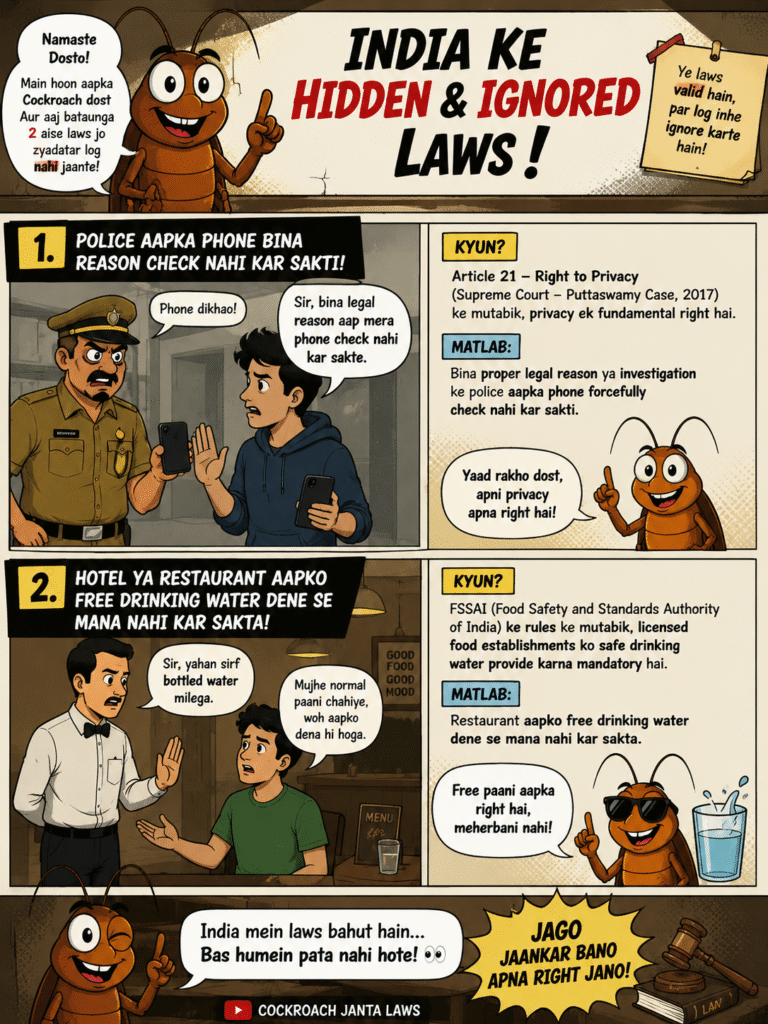
HIDDEN & IGNORED:- India has thousands of laws designed to protect citizens, maintain public order, and ensure fairness in society. From constitutional rights to consumer protections, these laws exist to give people security and dignity.
But the biggest problem is not the absence of laws — it is the lack of awareness.
Most people don’t know their own rights.
Because of this, many citizens silently accept situations that may actually be unfair, unlawful, or against their basic rights.
Sometimes people hand over their phones to authorities without understanding their privacy rights.
Sometimes restaurants force customers to buy bottled water even when they simply ask for regular drinking water. HIDDEN & IGNORED
People often assume But democracy works differently.
Laws are not made only for courtrooms or lawyers. They are made to protect ordinary citizens in everyday life.
When people understand their rights, they become more confident, informed, and responsible members of society. In this post, we’ll discuss two important but widely ignored rights that every Indian should know.
1. Police Cannot Check Your Phone Without Proper Legal Reason
Today, smartphones are not just devices.
They contain our entire digital life:
- Personal chats
- Photos and videos
- Banking details
- Emails
- Documents
- Social media accounts
- Private information
In many ways, a phone represents a person’s identity and privacy.
So the question is:
Can police officers check your phone anytime they want?
Many people believe that if a police officer says,
“Show me your phone,”
they have no option but to comply immediately.
However, the law is more nuanced than that.
Right to Privacy Is a Fundamental Right
Under Article 21 of the Indian Constitution, every citizen has the right to life and personal liberty.
In the landmark 2017 Supreme Court judgment:
Justice K.S. Puttaswamy vs Union of India
the Court declared that:
The Right to Privacy is a Fundamental Right.
This means your personal data and private information cannot be accessed arbitrarily or without lawful justification.
What Does This Mean Practically?
In ordinary situations, police authorities cannot casually or forcefully inspect your phone without a valid legal reason, investigation, or proper procedure.
If such a situation occurs, you can respectfully ask:
- What is the reason for checking the phone?
- Is there an official investigation?
- Is there any legal basis or order involved?
This does not mean citizens should become aggressive or obstruct lawful investigations.
It simply means privacy is protected under the Constitution and cannot be ignored casually. HIDDEN & IGNORED
Does This Mean Police Can Never Check a Phone?
No. That would also be incorrect.
Law enforcement agencies may legally inspect or seize devices in situations involving:
- Criminal investigations
- Warrants
- National security concerns
- Cybercrime inquiries
- Evidence collection under lawful procedures
The law attempts to maintain a balance between:
- Public safety
- Criminal investigation
- Individual privacy
The key issue is legality and procedure — not unchecked power. HIDDEN & IGNOREDHIDDEN & IGNORED
Why Most People Don’t Know This
There are several reasons:
1. Fear of Authority
Many people are afraid to question officials, even respectfully.
2. Lack of Legal Awareness
Basic legal education is rarely taught properly in schools or colleges.
3. Social Conditioning
People are often raised to believe:
“Authority is always right.”
But in a constitutional democracy, even authorities operate within legal limits.
What Should a Citizen Do?
If you ever face such a situation:
- Stay calm
- Do not argue aggressively
- Speak respectfully
- Ask questions politely
- Understand the situation carefully
- Seek legal help if necessary
Knowing your rights does not make you anti-police or anti-system.
It simply makes you an aware citizen.
2. Restaurants Cannot Refuse to Provide Safe Drinking Water
Now let’s discuss another ignored issue that affects millions of people daily.
Imagine going to a restaurant and asking:
“Can I get regular drinking water?”
And the staff responds:
“Only bottled water is available.”
Most customers stay silent and buy an expensive bottle without questioning it.
But is this completely justified?
What Do FSSAI Rules Say?
The Food Safety and Standards Authority of India (FSSAI) regulates food safety standards across the country.
According to food safety norms, licensed food establishments are expected to provide safe drinking water for consumers.
In simple terms:
A restaurant or food outlet must ensure that customers have access to safe potable water. HIDDEN & IGNORED
What Does This Mean in Real Life?
This does not necessarily mean luxury service or unlimited facilities.
However, forcing customers to buy bottled water while refusing normal safe drinking water raises important questions regarding consumer rights and hospitality standards. HIDDEN & IGNORED
Water is a basic necessity — not a luxury item.
Free Drinking Water Is a Basic Customer Facility
In many places, customers are made to feel uncomfortable for asking for normal water.
But think about it:
- Water is essential for health
- Drinking water is considered a basic hospitality facility
- Not every customer wants or can afford bottled water
- Restaurants already charge for food and service
Providing safe drinking water should be viewed as a standard customer facility, not a favor. HIDDEN & IGNORED
Why Do Customers Usually Stay Silent?
1. “It’s too small an issue”
People often avoid speaking up over everyday inconveniences.
2. Fear of Embarrassment
Some customers worry they may appear “cheap” or difficult.
3. Lack of Awareness
Many people simply do not know they can request regular drinking water.
What Should You Do?
If a restaurant refuses to provide drinking water:
- Politely ask if regular potable water is available
- Speak calmly with the staff
- Request to speak with the manager if needed
- Avoid arguments or rude behavior
Awareness is most effective when combined with maturity and respect.
The Bigger Problem: Lack of Awareness
India does not lack laws.
India lacks widespread legal awareness.
This is why:
- People often accept unfair treatment as “normal”
- Businesses sometimes avoid accountability
- Citizens feel powerless in ordinary situations
Awareness changes that.
An informed citizen is harder to exploit.
Knowing Your Rights Does Not Make You “Anti-System”
One dangerous misconception in society is that anyone who talks about rights is somehow rebellious or anti-authority.
But in reality:
- Citizens have rights
- Institutions have responsibilities
- Democracy depends on balance between both
Respectfully understanding your legal rights is not rebellion.
It is responsible citizenship.
The Role of Social Media in Legal Awareness
Today, platforms like YouTube, Instagram, and social media are spreading legal awareness faster than ever before.
This is a positive development.
People are learning:
- Consumer rights
- Privacy rights
- Workplace protections
- Basic legal remedies
However, there is also a risk:
Half Knowledge
Many creators exaggerate laws for views and engagement.
Some present complex legal matters in misleading or oversimplified ways.
That is why people should always:
- Verify information
- Refer to official sources
- Read authentic legal explanations
- Understand exceptions and limitations
Because every legal right also comes with conditions and procedures.
How Can Legal Awareness Improve?
1. Legal Education in Schools
Students should learn practical constitutional and civic rights.
2. Regional Language Awareness
Legal information should be available in simple local languages.
3. Social Media Campaigns
Short-form content can educate millions quickly.
4. Real-Life Examples
People understand laws better when explained through practical situations.
What Makes a Responsible Citizen?
A responsible citizen:
- Knows their rights
- Respects others’ rights
- Uses laws responsibly
- Stays calm during conflicts
- Avoids spreading misinformation
- Understands both rights and duties
Rights and responsibilities always go together.
Conclusion
Laws are not meant only for lawyers, courts, or government officials.
They exist to protect ordinary people in everyday life.
Whether it is:
- Digital privacy,
or - Basic consumer facilities,
every citizen deserves to understand their fundamental rights.
Because:
An unaware citizen is the easiest to exploit.
And remember:
Awareness is not about fighting the system.
Awareness is about understanding your place within it.
India does not really have “hidden laws.”
What is hidden is public awareness. HIDDEN & IGNORED
Stay informed.
Stay aware.
Know your rights.
https://www.youtube.com/@cockroachJantaLaws/shorts
https://advawanti.com/wp-admin/post.php?post=5311&action=edit