“Just a Joke?” — Where Does the Line Get Crossed in the Workplace
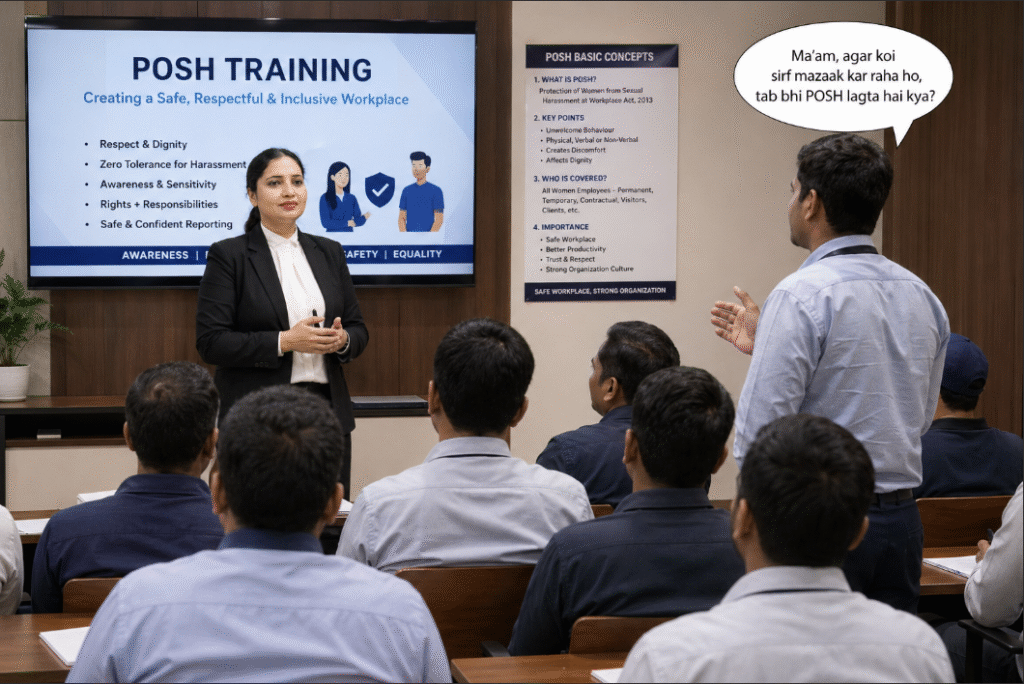
“Ma’am, if someone is just joking… does POSH still apply?”
This question came up during one of my recent POSH training sessions.
And honestly, it wasn’t just a question — it was a mirror reflecting the reality of most workplaces today.
We use the phrase “just joking” very casually in our day-to-day lives.
It feels harmless, friendly, and often even necessary to build rapport. Humor, after all, is a part of human interaction. It helps people connect, break the ice, and feel comfortable.
But here’s the uncomfortable truth:
What feels like “just a joke” to one person can feel deeply uncomfortable, disrespectful, or even threatening to another.
And that’s exactly where the complexity of workplace behavior begins.
In a professional environment, intention is not the only factor that matters — perception matters just as much, if not more.
Let’s be clear:
Not every joke is harassment.
But…
The moment a comment, gesture, or behavior makes even one individual feel uneasy, awkward, disrespected, or unsafe, it stops being “just a joke.”
And this is where the real challenge of POSH begins.
Just a Joke The Law is Clear — But Is It Understood?
From a legal standpoint, there is very little ambiguity.
The POSH law clearly defines what constitutes sexual harassment. It elaborates on different forms — whether verbal, non-verbal, physical, or even implied through gestures or tone. It also lays down the consequences, the redressal mechanisms, and the responsibilities of both employers and employees.
The intention behind such detailed legal structuring is simple:
To eliminate confusion and create clarity.
Employees are meant to understand:
- What behavior is acceptable” goes beyond simply following written rules — it involves understanding and practicing conduct that is respectful, professional, and mindful of others’ boundaries at all times. Acceptable behavior in the workplace means communicating in a way that is courteous and inclusive, ensuring that words, gestures, or actions do not make anyone feel uncomfortable, excluded, or disrespected. It also includes being aware of personal space, maintaining appropriate tone and language, and recognizing that what may seem normal or friendly to one person may not be perceived the same way by another. Ultimately, acceptable behavior is about creating an environment where every individual feels safe, valued, and respected, without fear of judgment, discomfort, or harm. Just a Joke
- “What crosses the line” refers to any behavior that goes beyond professional boundaries and creates discomfort, unease, or a sense of disrespect for another person, regardless of the intent behind it. It includes actions, words, or gestures that may seem casual or harmless to one individual but are unwelcome or inappropriate to another. Crossing the line often happens when personal comments, jokes, or interactions start affecting someone’s dignity, privacy, or sense of safety. This can involve repeated remarks, suggestive language, intrusive questions, unwanted attention, or any conduct that ignores verbal or non-verbal cues of discomfort. Importantly, a line is considered crossed not when the speaker decides it, but when the receiver feels impacted negatively. Recognizing this boundary requires awareness, empathy, and the ability to understand that professionalism is defined not just by intention, but by how one’s behavior is experienced by others. Just a Joke
- “What rights they have” refers to every employee’s entitlement to work in an environment that is safe, respectful, and free from any form of harassment or discrimination. Employees have the right to be treated with dignity, to express discomfort without fear of being ignored or judged, and to have their concerns taken seriously. They also have the right to report inappropriate behavior through a proper mechanism without fear of retaliation, victimization, or damage to their professional reputation. In addition, they are entitled to a fair, confidential, and unbiased inquiry process if a complaint is made, along with protection of their identity and well-being throughout the proceedings. These rights ensure that individuals are not left to handle uncomfortable or harmful situations alone, and that the organization takes active responsibility in maintaining a secure and supportive workplace for everyone. Just a Joke
- “What responsibilities they must uphold” refers to the duty of every employee to contribute to a safe, respectful, and professional workplace environment through their own behavior and actions. This includes being mindful of how they communicate, ensuring that their words, jokes, gestures, or interactions do not make others feel uncomfortable or disrespected. Employees are responsible for maintaining appropriate boundaries, respecting personal space, and understanding that consent and comfort are essential in all professional interactions. It also involves adhering to organizational policies, participating in awareness programs like POSH training, and taking such guidelines seriously in day-to-day conduct. Just a Joke
Similarly, organizations are expected to ensure that:
- “The law is communicated effectively” means that employees are not just formally informed about policies, but are given a clear, practical, and relatable understanding of what the law actually requires in day-to-day workplace situations. It involves explaining legal provisions in simple, accessible language rather than complex jargon, so that every employee—regardless of role or background—can understand their rights, responsibilities, and boundaries. Effective communication also ensures that employees know how to identify inappropriate behavior, what steps to take in case of a concern, and how the complaint mechanism works. Just a Joke
- “Awareness is created regularly” means that organizations make continuous and consistent efforts to keep employees informed, sensitized, and updated about workplace behavior, boundaries, and POSH guidelines. It is not limited to a one-time training session, but involves ongoing communication through workshops, refresher sessions, internal campaigns, emails, posters, and real-life scenario discussions. Regular awareness ensures that employees do not forget, ignore, or misunderstand important concepts over time. It also helps reinforce the idea that respectful behavior is not optional, but an integral part of workplace culture. Through repeated engagement, employees become more confident in identifying inappropriate conduct, understanding their rights and responsibilities, and responding appropriately when situations arise. Ultimately, creating awareness regularly ensures that POSH is not treated as a yearly formality, but as a continuous learning process that strengthens a safe, respectful, and inclusive work environment. Just a Joke
- “Awareness is created regularly” means that organizations make continuous and consistent efforts to keep employees informed, sensitized, and updated about workplace behavior, boundaries, and POSH guidelines. It is not limited to a one-time training session, but involves ongoing communication through workshops, refresher sessions, internal campaigns, emails, posters, and real-life scenario discussions. Regular awareness ensures that employees do not forget, ignore, or misunderstand important concepts over time. It also helps reinforce the idea that respectful behavior is not optional, but an integral part of workplace culture. Through repeated engagement, employees become more confident in identifying inappropriate conduct, understanding their rights and responsibilities, and responding appropriately when situations arise. Ultimately, creating awareness regularly ensures that POSH is not treated as a yearly formality, but as a continuous learning process that strengthens a safe, respectful, and inclusive work environment. Just a Joke
On paper, everything is structured.
Policies Exist — But Are They Internalized?
Most organizations today have well-documented POSH policies.
These policies typically outline:
- “Definitions of harassment” refer to a clear and detailed explanation of what constitutes inappropriate or unacceptable behavior in the workplace, so that there is minimal scope for confusion or misinterpretation. It includes various forms of conduct—verbal, non-verbal, physical, and even digital—that may be unwelcome, offensive, or create an uncomfortable or hostile work environment for an individual. Just a Joke
- “Reporting procedures” refer to the clearly defined steps and mechanisms through which an employee can raise a concern or file a complaint in case of inappropriate behavior or harassment at the workplace. These procedures are designed to ensure that every individual knows exactly where to go, whom to approach, and how to report an issue in a structured and secure manner. Just a Joke
- “Complaint mechanisms” refer to the structured systems and processes established within an organization to receive, address, and resolve complaints related to harassment or inappropriate behavior in a fair and effective manner. These mechanisms ensure that employees have a reliable and accessible way to voice their concerns without fear or hesitation. Just a Joke
- Disciplinary actions” refer to the corrective and punitive measures an organization may take when an employee is found to have engaged in inappropriate behavior or violated workplace policies, including those under POSH. These actions are not arbitrary—they are based on the findings of a fair and unbiased inquiry process, and are meant to address the misconduct while maintaining workplace discipline and safety. Just a Joke
- “Expected workplace behavior” refers to the standard of conduct that every employee is required to maintain in order to create a professional, respectful, and safe working environment. It includes interacting with colleagues in a manner that is courteous, inclusive, and mindful of boundaries, ensuring that communication—whether verbal, non-verbal, or digital—remains appropriate at all times. Employees are expected to treat others with dignity, avoid any form of offensive language, jokes, or gestures, and be sensitive to differences in gender, culture, and personal comfort levels. Just a Joke
They are shared during onboarding, uploaded on internal portals, and sometimes even discussed in brief sessions.
But here’s the gap:
Policies are often read… but rarely understood.
Employees may know that a policy exists,
but they often don’t fully grasp how it applies in real-life situations.
They don’t always recognize:
- When a “friendly comment” becomes inappropriate
- When a “compliment” turns into discomfort
- When “casual behavior” crosses professional boundaries
And this gap between written policy and real-world understanding is where problems start to emerge.
Committees Are Formed — But Are Employees Comfortable?
Organizations also ensure compliance by forming Internal Committees (ICs), as mandated under POSH.
These committees are structured with:
- Trained members
- External experts
- Defined procedures
- Confidential handling mechanisms
Their purpose is to ensure that:
- Complaints are addressed fairly
- Investigations are unbiased
- Victims feel supported
- Justice is delivered appropriately
But despite all of this, a critical question remains:
Do employees actually feel safe approaching these committees?
In many cases, the answer is — not always.
Why?
Because:
- They are unsure whether their experience “qualifies” as harassment
- They fear being judged or misunderstood
- They worry about consequences or backlash
- They hesitate due to lack of clarity
And again, the root cause is not absence of structure —
it is absence of understanding.
So Why Do Problems Still Exist?
If the law is clear,
policies are documented,
and committees are formed…
Then why do issues persist?
The answer is simple — yet uncomfortable:
Confusion.
There is widespread confusion between:
✔ Friendly behavior vs. inappropriate behavior
✔ Compliment vs. comment
✔ Comfort vs. consent
✔ Humor vs. disrespect
✔ Informality vs. unprofessional conduct
And this confusion is not limited to employees alone.
Even managers and leadership often struggle with these distinctions.
Because these are not always black-and-white situations.
They exist in shades of grey — shaped by context, tone, relationship, and perception. Just a Joke
What Happens When There Is No Clarity?
When people are unsure, two extreme responses typically emerge:
1. Silence
Individuals who feel uncomfortable often choose to stay quiet.
They second-guess themselves.
They minimize their own discomfort.
They think, “Maybe I’m overreacting.”
Over time, this silence builds into frustration, resentment, and emotional distress.
2. Escalation
On the other hand, situations that could have been addressed early often escalate into formal complaints.
What could have been resolved through awareness and communication
turns into a legal and organizational issue. Just a Joke
And both outcomes are unhealthy for a workplace.
What I Have Observed as a POSH Trainer
As someone who regularly conducts POSH training sessions and serves as an External Member, I have consistently observed one pattern across organizations:
Most organizations achieve compliance…
but very few achieve clarity.
They:
✔ Conduct trainings
✔ Share policies
✔ Form committees
But the deeper objective —
building real understanding — often remains unfulfilled.
And without that understanding:
❌ Employees remain confused
❌ Victims hesitate to speak
❌ Individuals unknowingly cross boundaries
❌ Workplace culture becomes fragile
The Real Purpose of POSH Training
POSH training is often treated as a checkbox activity.
A mandatory session.
A yearly compliance requirement.
A formal presentation.
But its real purpose goes far beyond that.
It is not just about explaining the law.
It is about helping people understand:
👉 What behavior is acceptable
👉 What impact their actions can have
👉 How to recognize discomfort — in themselves and others
👉 How to maintain professional boundaries
👉 How to create a respectful environment
Because at the end of the day,
a safe workplace is not built by rules alone — it is built by awareness and sensitivity.
A Shift in Mindset Is Needed
We need to move from:
“I didn’t mean anything wrong”
to
“Did it make someone uncomfortable?”
From:
“It was just a joke”
to
“Was it appropriate in a professional space?”
From:
“I was being friendly”
to
“Was it respectful and welcome?”
This shift — from intention to impact — is the foundation of a truly safe workplace.
A Question for Every Organization
If you are part of leadership, HR, or management, ask yourself:
Are your employees merely aware of the rules?
Or do they actually understand their meaning?
Because knowing the law is not enough.
Understanding behavior is what truly prevents issues.
Final Thought
A workplace does not become safe because policies exist.
It becomes safe when:
- People are aware
- People are sensitive
- People are respectful
- People are responsible
Because ultimately,
Safety is not a document.
It is a culture.
#POSHTraining #WorkplaceEthics #SafeWorkplace #HRLeadership #CorporateCulture
https://www.youtube.com/@LegistraLaw/shorts
https://advawanti.com/wp-admin/post.php?post=5269&action=edit