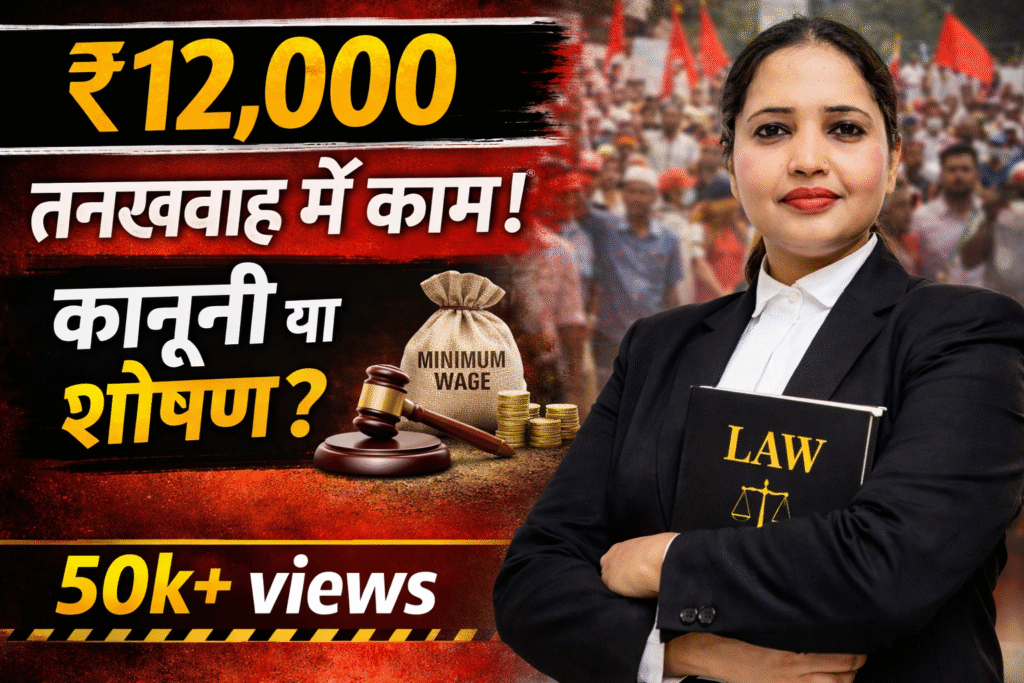
Legal Compliance In recent times, a growing concern has emerged across various industries in India—workers being paid as low as ₹12,000 per month, often without any statutory benefits such as Provident Fund (PF), Employee State Insurance (ESI), bonus, or even proper overtime compensation. What makes the issue more alarming is that this trend is not limited to one sector; it is visible across manufacturing units, small and medium enterprises, service industries, and even in certain organized establishments.
At first glance, ₹12,000 may appear to be a basic entry-level wage. However, when viewed against the backdrop of rising inflation, increasing cost of living, and expanding economic demands on individuals, this amount raises serious questions about sustainability and fairness. For many workers, this salary must cover essential expenses such as rent, food, transportation, healthcare, and family responsibilities—making it extremely difficult to maintain even a minimum standard of living. Legal Compliance
The concern deepens further when such wages are paid without compliance with statutory labour laws. In several cases, workers are either unaware of their legal entitlements or are unable to assert them due to job insecurity and lack of bargaining power. The absence of formal appointment letters, wage slips, and documented employment terms adds another layer of vulnerability, leaving workers with little to no protection in case of disputes. Legal Compliance
From a legal standpoint, this situation brings into focus the framework established under the Minimum Wages Act, 1948, which mandates that employers must pay at least the minimum wage prescribed by the appropriate government, depending on the nature of work, skill category, and geographical location. Additionally, compliance with other labour welfare legislations is not optional but mandatory, aimed at ensuring social security and dignified working conditions for employees. Legal Compliance
This issue has therefore sparked widespread debate—not just on social media platforms, but also among legal professionals, policymakers, labour unions, and industry stakeholders. Questions are being raised about whether such wage practices are merely a reflection of economic constraints or whether they cross the line into systemic exploitation. It also opens up a broader discussion on enforcement gaps, regulatory oversight, and the need for greater awareness among workers regarding their rights.
In essence, the ₹12,000 salary debate is no longer just about numbers—it represents a deeper conflict between legal compliance, economic reality, and the fundamental principle of fairness in employment.o answer this, one must examine the legal framework governing wages and employee rights in India.
⚖️ Legal Compliance or Legal Framework Governing Wages in India
The foundation of wage regulation in India lies in the
👉 Minimum Wages Act, 1948,
which was enacted to protect workers from exploitation and ensure they receive fair compensation for their labour. The Act empowers both Central and State Governments to fix minimum wage rates based on factors such as skill level, nature of work, and geographical location. These wages are not just a fixed amount but usually include a basic component along with Variable Dearness Allowance (VDA), which adjusts with inflation. Importantly, the law makes it mandatory for employers to pay at least the prescribed minimum wages, and any payment below this threshold is considered a violation, regardless of employee consent. This framework plays a crucial role in maintaining a balance between employer interests and worker rights, ensuring that every individual earns at least a basic standard of livelihood.
This law mandates that every employer must pay at least the minimum wage fixed by the appropriate government. These wages vary depending on:
- Skill level refers to the classification of workers based on the nature of their work, training, and expertise. Generally, employees are categorized as unskilled, semi-skilled, or skilled. Unskilled workers are those who perform simple tasks that do not require formal training or specialized knowledge. Semi-skilled workers possess a basic level of training and can perform tasks with some supervision or guidance. Skilled workers, on the other hand, have specialized training, experience, and expertise, enabling them to perform complex tasks independently and efficiently. This classification helps in determining appropriate wages, responsibilities, and compliance with labour standards. Legal Compliance
- Nature of employment refers to the type and terms of work under which an employee is engaged in an organization. It explains whether the employment is permanent, temporary, contractual, daily wage, or part-time in nature. It also reflects the stability, duration, and conditions of the job relationship between the employer and the employee. Understanding the nature of employment is important as it determines job security, benefits, legal rights, and obligations of both parties under applicable labour laws and workplace policies. Legal Compliance
- Geographical location refers to the physical place where an employee is required to perform their duties or where the establishment operates. It may include specific cities, states, regions, or even remote or on-site project locations depending on the nature of work. This factor is important because it can influence working conditions, applicable labour laws, cost of living adjustments, and accessibility of resources. In some cases, geographical location also determines allowances, travel requirements, and other employment-related benefits provided to the employee. Legal Compliance
Additionally, minimum wages include two components:
- Basic Wage: Basic Wage is the fixed component of an employee’s salary that is paid for the work performed, excluding any allowances, bonuses, or additional benefits. It forms the core part of the salary structure and is generally determined based on factors such as job role, skill level, experience, and industry standards. Basic wage is important because many statutory benefits like provident fund, gratuity, and other social security contributions are calculated on its basis. It also serves as a reference point for determining overtime pay and other wage-related entitlements under applicable labour laws. Legal Compliance
- Variable Dearness Allowance (VDA), which adjusts with inflation: Variable Dearness Allowance (VDA) is a component of wages that is provided to employees to compensate for the impact of inflation and rising cost of living. Unlike basic wage, VDA is not fixed and is periodically revised by the government based on changes in the Consumer Price Index (CPI). Its main purpose is to ensure that workers’ real income remains stable despite fluctuations in market prices. VDA is an important part of the wage structure, as it helps maintain purchasing power and is often considered while calculating total wages and statutory compliance under labour laws. Legal Compliance
👉 Therefore, paying a fixed amount like ₹12,000 without factoring in the Variable Dearness Allowance (VDA) may raise serious compliance concerns. Since VDA is designed to offset the impact of inflation and is revised periodically by the government, excluding it from the wage structure can result in the total pay falling below the legally prescribed minimum wage. In such cases, even if the fixed salary appears close to the minimum threshold, it may still amount to underpayment under labour laws, thereby exposing the employer to potential legal liability. Legal Compliance
📊 Understanding the ₹12,000 Salary Issue
At first glance, ₹12,000 may appear to fall within the minimum wage range for certain categories of workers. However, its legality cannot be determined solely on this figure, as it depends on multiple factors. These include the applicable state minimum wage notification, the nature of employment, the skill level of the worker, and the inclusion of components such as Basic Wage and Variable Dearness Allowance (VDA). In addition, compliance must also account for working hours, overtime payments, and other statutory benefits mandated under labour laws. Therefore, a proper assessment requires a detailed examination of all these elements rather than relying on a single consolidated wage amount.
1. Skill Classification
If the worker is:
- For skilled workers, ₹12,000 is likely to fall below the legally prescribed minimum wage threshold in many jurisdictions. The minimum wage for skilled categories is generally higher due to their specialized knowledge and expertise. Therefore, paying ₹12,000 may not comply with the applicable wage notification and could amount to underpayment under labour laws. Legal Compliance
- For semi-skilled workers, a wage of ₹12,000 may be borderline or potentially non-compliant, depending on the applicable state minimum wage notification and the inclusion of components like VDA. In many cases, the prescribed minimum wage for semi-skilled categories is higher, and if statutory requirements are not fully met, it could result in a violation of labour laws. Legal Compliance
- For unskilled workers, a wage of ₹12,000 may appear to be compliant in some cases; however, it still requires deeper scrutiny. Compliance depends on the applicable state-specific minimum wage rates, inclusion of Variable Dearness Allowance (VDA), and other statutory components. Therefore, a proper assessment is necessary to confirm whether the wage structure fully meets legal requirements. Legal Compliance
2. Working Hours & Overtime
Under Indian labour laws:
- Standard working hours are fixed
- Overtime must be compensated separately
👉If a worker earning ₹12,000 per month is required to work beyond the prescribed standard working hours without being paid overtime, it clearly amounts to a violation of labour laws. Indian labour regulations mandate that any work performed beyond normal working hours must be compensated at a higher overtime rate. Denial of such compensation not only results in unfair labour practice but also reflects non-compliance with statutory obligations, making the employer liable for legal action and penalties. Legal Compliance
3. Absence of Statutory Benefits
A major red flag arises when workers are paid ₹12,000 without benefits such as:
- Provident Fund (PF)
- Employee State Insurance (ESI)
- Bonus
These are governed by:
- Employees’ Provident Funds and Miscellaneous Provisions Act, 1952
- Employees’ State Insurance Act, 1948
- Payment of Bonus Act, 1965
👉 Non-compliance with these statutory labour laws can lead to serious legal consequences for employers, including monetary penalties, prosecution, and directions for payment of pending dues. Authorities may initiate inspections and inquiries, and in proven cases, employers can be compelled to compensate workers for unpaid wages, benefits, or contributions. Repeated or willful violations may further strengthen the case against the employer, exposing them to stricter enforcement actions and reputational damage. Legal Compliance
⚠️ The Contract Labour Loophole
Many organizations attempt to bypass compliance by categorizing workers as contract labour. However, under
👉 Contract Labour (Regulation and Abolition) Act, 1970
The principal employer cannot completely evade responsibility.
👉 Even if workers are engaged through contractors, the principal employer cannot escape responsibility for statutory compliance. The law places a clear obligation on the company to ensure that all workers, whether directly employed or hired through a contractor, receive minimum wages, statutory benefits, and lawful working conditions. Any lapse on the part of the contractor does not absolve the company, making it equally liable for violations and subject to legal consequences. Legal Compliance
💥 Economic Reality vs Legal Obligation
In today’s economic environment, ₹12,000 often falls short of meeting basic living expenses. While the law focuses on minimum thresholds, the ethical dimension cannot be ignored.
When:
- Company profits are increasing
- The cost of living is rising
- Yet worker wages remain stagnant
👉 This situation creates not only a legal imbalance but also a moral one. When rules are not applied equally or one party gains an unfair advantage, it undermines the principle of justice. From a legal perspective, it may amount to a violation of applicable laws, while from a moral standpoint, it goes against fairness, honesty, and ethical conduct. Such imbalance, over time, weakens trust in the system and can lead to dissatisfaction and a sense of injustice within society. Legal Compliance
⚖️ Legal Remedies Available to Workers
Workers who believe they are underpaid or denied benefits can:
- File a complaint with the Labour Commissioner
- Seek inspection and inquiry
- Claim back wages and compensation
In certain cases, employers may also face penalties for non-compliance with applicable laws and regulations. When statutory obligations such as minimum wages, working hours, overtime payments, or other labour law requirements are not properly followed, authorities may impose fines, legal action, or other corrective measures against the employer. Such penalties are intended to ensure accountability and to encourage strict adherence to labour welfare standards, thereby protecting the rights and interests of workers.
🎯 Conclusion
The issue of ₹12,000 salary is not merely about numbers—it is about rights, dignity, and legal compliance.
👉 If the wage meets all legal requirements, it may be technically valid.
👉 However, if it falls short of statutory norms or excludes benefits, it may amount to labour exploitation under the law.
https://www.youtube.com/@LawbyAdvocateAwanti
https://advawanti.com/wp-admin/post.php?post=5256&action=edit