Freedom of Opinion & Expression in India: Legal Framework, Limits & Challenges: In any democratic society, the ability to think freely and express those thoughts without fear is not just a privilege, it is a fundamental right. The Right to Freedom of Opinion & Expression forms the backbone of an open, accountable, and participatory system of governance. It enables individuals to question authority, share ideas, engage in public discourse, and contribute meaningfully to the democratic process.
This right is not limited to speaking openly; it also includes the freedom to form opinions, access information, and communicate ideas through various platforms—whether traditional media or digital spaces. In many ways, it acts as a safeguard against arbitrary use of power, ensuring that governments remain answerable to the people they serve.
At the same time, the true essence of this right lies not merely in its existence, but in its exercise. A society may formally recognize freedom of expression, but its real strength is tested by how comfortably individuals can express dissenting or unpopular views without fear of backlash or consequences.
In India, the legal framework governing this right has evolved to strike a balance between liberty and responsibility, making it both powerful and nuanced in its application.
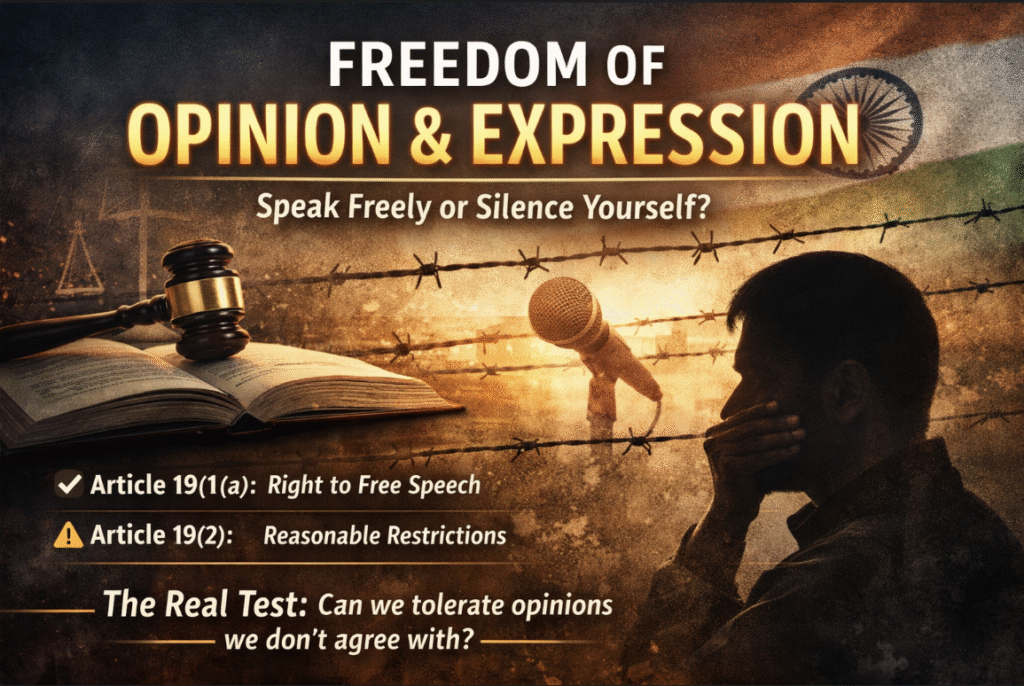
Freedom of Opinion & Expression in India: Legal Framework, Limits & Challenges: In India, the right to freedom of opinion and expression is not merely a philosophical ideal but a constitutionally protected guarantee. It finds its place under
👉 Article 19(1)(a) of the Indian Constitution,
which ensures that every citizen has the freedom of speech and expression.
This provision empowers individuals to express their thoughts, share opinions, question authority, and participate actively in public discourse. It extends to various forms of expression, including spoken and written words, artistic representations, digital communication, and media platforms. In essence, it enables citizens to engage with society, influence public opinion, and contribute to democratic functioning.
However, this right operates within a structured legal framework that seeks to balance individual liberty with the broader interests of society. Over time, judicial interpretations have further shaped its scope, clarifying what constitutes protected expression and where limitations may arise.
As a result, while the Constitution strongly safeguards this freedom, its practical application involves navigating both its empowering potential and its inherent limitations—making it one of the most dynamic and debated rights in the Indian legal system.
Freedom of Opinion & Expression in India: Legal Framework, Limits & Challenges: However, while the right exists on paper and in principle, its real-world application often raises complex legal and social questions. Freedom of Opinion & Expression in India: Legal Framework, Limits & Challenges
⚖️ Understanding the Legal Framework
Freedom of Opinion & Expression in India: Legal Framework, Limits & Challenges. The Constitution ensures that every individual has the right to express opinions through speech, writing, print, or any other mode of communication. This freedom is wide in its scope and includes not just the act of speaking, but also the right to convey ideas, share perspectives, and communicate information across different platforms.
In today’s context, this right extends beyond traditional forms of expression to include digital and social media, where individuals actively participate in discussions, raise concerns, and shape public opinion. Whether it is through articles, posts, interviews, or creative expressions, the essence of this right lies in enabling individuals to make their voices heard.
Importantly, this freedom also includes the right to receive information and ideas, making it a two-way process that strengthens awareness and informed decision-making in society. It plays a crucial role in promoting transparency, encouraging debate, and ensuring that multiple viewpoints can coexist within a democratic framework.
At its core, this right empowers individuals not just to speak, but to participate meaningfully in the social, political, and legal discourse of the country.
This includes:
- Expressing personal views and beliefs is a fundamental aspect of the right to freedom of opinion and expression. It allows individuals to share their thoughts, values, and perspectives openly, whether in private conversations or public forums. This freedom enables people to shape their identity, participate in discussions, and contribute to a diverse exchange of ideas in society
- Criticizing government policies is an essential component of the right to freedom of opinion and expression. It allows individuals to question decisions, highlight shortcomings, and hold authorities accountable. Such criticism, when expressed responsibly, plays a vital role in strengthening democratic governance and ensuring transparency in public administration.
- Participating in public discourse is a key element of the right to freedom of opinion and expression. It enables individuals to engage in discussions on social, political, and legal issues, share diverse perspectives, and contribute to collective decision-making. Such participation fosters informed debate and strengthens the democratic fabric of society.
- Sharing ideas through digital and social media platforms has become a significant aspect of the right to freedom of opinion and expression in today’s interconnected world. It allows individuals to communicate instantly with a wide audience, exchange views, raise awareness on important issues, and actively participate in shaping public opinion beyond geographical boundaries.
However, it is equally important to understand that this right is not absolute.
Under
👉 Article 19(2) of the Indian Constitution,
the State is empowered to impose reasonable restrictions in the interest of:
- Sovereignty and integrity of India refer to the need to protect the nation’s unity, independence, and territorial boundaries. As a ground for restriction on freedom of expression, it ensures that no speech or expression threatens the stability, security, or existence of the country as a unified entity.
- Security of the State refers to the protection of the nation against serious threats such as war, external aggression, or internal disturbances that may endanger its stability. As a ground for restricting freedom of expression, it ensures that no speech or activity compromises national security or aids forces that threaten the safety and integrity of the State.
- Public order refers to the maintenance of peace, safety, and normal functioning of society. As a ground for restricting freedom of expression, it ensures that no speech or activity incites violence, unrest, or disruption that could disturb the harmony and stability of the community.
- Decency and morality refer to the accepted standards of behavior and ethical values within society. As a ground for restricting freedom of expression, it ensures that speech or content does not become obscene, offensive, or harmful to societal norms, particularly in a way that may negatively impact public sensibilities or dignity.
- Defamation refers to the act of making false statements about a person that harm their reputation. As a ground for restricting freedom of expression, it ensures that individuals are protected against unjust attacks on their character or credibility, balancing free speech with the right to dignity.
- Contempt of court refers to any act or expression that undermines the authority, dignity, or functioning of the judiciary. As a ground for restricting freedom of expression, it ensures that public confidence in the judicial system is maintained and that the administration of justice is not obstructed or prejudiced.
This balance ensures that while individuals are free to express themselves, such freedom does not infringe upon the rights of others or disrupt societal harmony. Freedom of Opinion & Expression in India: Legal Framework, Limits & Challenges
🧠The Real Challenge: Beyond Legal Text
While the constitutional provisions are clear, the real challenge lies in how this right is exercised in practice. Freedom of Opinion & Expression in India: Legal Framework, Limits & Challenges
In today’s environment, a subtle but significant shift can be observed—from external censorship to internal restraint. Freedom of Opinion & Expression in India: Legal Framework, Limits & Challenges
Many individuals hesitate to express their views openly, not necessarily due to legal restrictions, but because of: Freedom of Opinion & Expression in India: Legal Framework, Limits & Challenges
- Fear of backlash or trolling refers to the anxiety individuals experience about negative reactions, online harassment, or public criticism when expressing their views. This fear often discourages people from speaking openly, leading to self-censorship and limiting the free exchange of ideas in society.
- Social or professional consequences refer to the potential impact that expressing one’s opinions may have on personal relationships, reputation, or career opportunities. The fear of being judged, isolated, or facing workplace repercussions often leads individuals to restrain their views, contributing to self-censorship despite having the legal right to express themselves.
- Being misunderstood or misrepresented refers to the risk that one’s words or intentions may be taken out of context, incorrectly interpreted, or portrayed in a misleading manner. This concern often makes individuals cautious about expressing their views, as miscommunication can lead to unnecessary conflict, reputational harm, or unintended consequences.
This phenomenon, often referred to as self-censorship, can be more limiting than formal restrictions imposed by law. Freedom of Opinion & Expression in India: Legal Framework, Limits & Challenges
🌐 Freedom of Expression in the Digital Age
The rise of social media has amplified voices like never before. Today, anyone with internet access can share opinions instantly with a global audience. Freedom of Opinion & Expression in India: Legal Framework, Limits & Challenges
Freedom of Opinion & Expression in India: Legal Framework, Limits & Challenges While this has strengthened democratic participation, it has also led to:
- Rapid spread of misinformation refers to the quick and widespread circulation of false or misleading information, especially through digital and social media platforms. This can distort public understanding, influence opinions unfairly, and create confusion, making it essential to approach information sharing with accuracy and responsibility.
- Increased instances of hate speech refer to the growing use of language that promotes hostility, discrimination, or violence against individuals or groups based on identity factors such as religion, caste, gender, or ethnicity. This trend not only harms targeted communities but also disrupts social harmony, making it necessary to balance free expression with safeguards against such harmful speech.
- Blurred lines between opinion and defamation refer to the difficulty in distinguishing between a personal viewpoint and a statement that can harm someone’s reputation. While opinions are generally protected, they can cross into defamation if presented as false facts or if they unjustly damage an individual’s credibility, making it important to exercise caution while expressing views publicly.
Freedom of Opinion & Expression in India: Legal Framework, Limits & Challenges As a result, the responsibility to exercise this right wisely has become more important than ever.
Freedom of expression must be accompanied by accountability and awareness.
⚖️ Striking the Right Balance
Freedom of Opinion & Expression in India: Legal Framework, Limits & Challenges A healthy democracy does not demand uniformity of thought—it thrives on diversity of opinions.
The true essence of this right lies in:
- Respecting differing viewpoints
- Encouraging constructive criticism
- Maintaining civility in discourse
Freedom of Opinion & Expression in India: Legal Framework, Limits & Challenges Disagreement should not be seen as hostility, and expression should not be confused with disruption.
📌 Legal Remedies in Case of Violation
Freedom of Opinion & Expression in India: Legal Framework, Limits & Challenges If an individual’s right to freedom of expression is unlawfully restricted, several remedies are available:
- Filing a writ petition before the High Court or Supreme Court
- Approaching the
👉 National Human Rights Commission of India - Seeking appropriate legal recourse through courts
Freedom of Opinion & Expression in India: Legal Framework, Limits & Challenges Legal safeguards exist to ensure that this fundamental right is protected and upheld.
🔍 Conclusion: The True Test of Freedom
Freedom of Opinion & Expression in India: Legal Framework, Limits & Challenges Freedom of opinion and expression is not truly tested when we express ideas that are widely accepted. Its real test lies in protecting the space for opinions that challenge, question, or differ from the majority.
Freedom of Opinion & Expression in India: Legal Framework, Limits & Challenges A society that values free expression must also cultivate the ability to listen, tolerate, and engage.
Freedom of Opinion & Expression in India: Legal Framework, Limits & Challenges Because ultimately,
Freedom of expression is not just about the right to speak—
it is about creating an environment where speaking is possible without fear.
https://www.youtube.com/@LawbyAdvocateAwanti
https://advawanti.com/wp-admin/post.php?post=5237&action=edit