Is the POSH Law Ready for the Digital Age?**
Workplace harassment is no longer limited to physical spaces or face-to-face interactions.
AI, Deepfakes & Workplace Harassment: In this digital landscape, understanding AI and its implications is crucial for both employers and employees.
Employers must recognize the role of AI in these evolving dynamics.
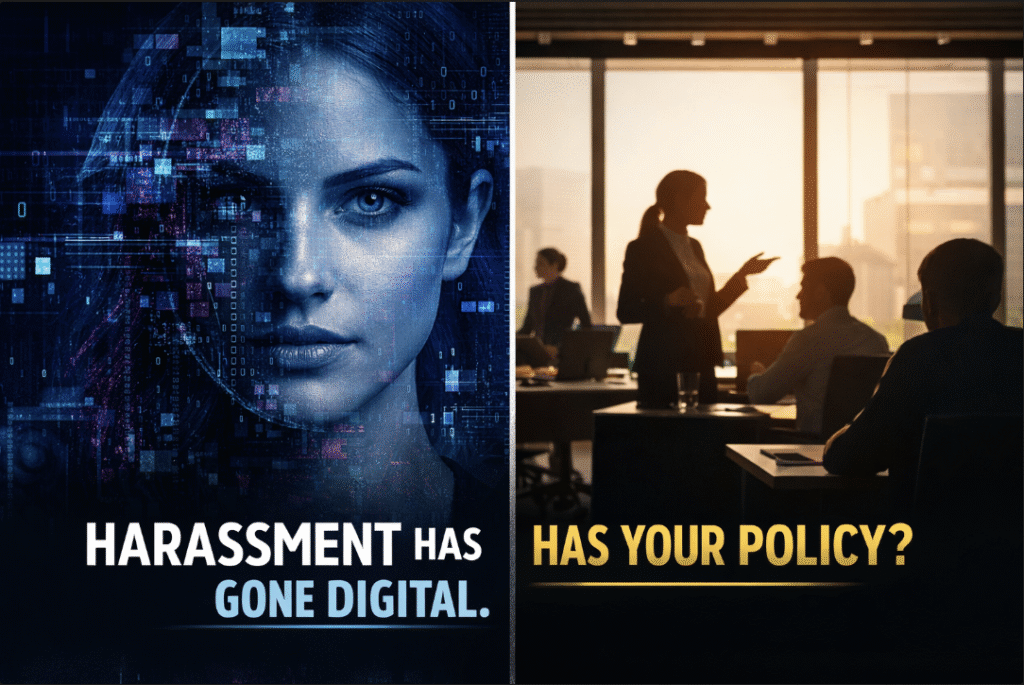
AI, Deepfakes & Workplace Harassment
AI, Deepfakes & Workplace Harassment With the rapid rise of Artificial Intelligence (AI), deepfake technology, and advanced digital manipulation tools, workplace harassment has evolved into a far more complex and sophisticated phenomenon than ever before. Harassment is no longer confined to physical spaces or direct human interaction; instead, employees may now be subjected to misconduct,
AI, Deepfakes & Workplace Harassment The harm caused by such acts is not abstract or theoretical; it is real, immediate, and often long-lasting. Even when the misconduct occurs entirely in the digital space, its consequences deeply affect the dignity, mental health, and professional reputation of the aggrieved individual. Victims may experience anxiety, stress, fear, loss of confidence, and emotional distress, which can directly impact their performance,
⚖️ Where Does the POSH Act Stand?
AI, Deepfakes & Workplace Harassment The Sexual Harassment of Women at Workplace (Prevention, Prohibition and Redressal) Act, 2013, was enacted at a time when the concept of Artificial Intelligence–driven harassment, deepfake technology, and sophisticated digital manipulation had not yet emerged or entered mainstream workplace realities. The law was framed in an era where workplace misconduct was largely understood in terms of physical presence, direct communication, and identifiable human actions, with limited anticipation of technology-enabled abuse.
🔍 Understanding Deepfakes & Workplace Harassment:
AI, Deepfakes & Workplace Harassment Understanding the implications of AI in workplace harassment cases can help in developing effective strategies.
However, the law is principle-based, not technology-specific.
This means:
AI technologies are reshaping the dynamics of workplace interactions significantly.
Understanding the implications of AI can empower employees to navigate their rights.
- Physical presence is not mandatory for harassment:
Under the POSH Act, an act of sexual harassment does not require physical proximity or face-to-face interaction between the parties. The law acknowledges that inappropriate conduct can occur beyond the physical boundaries of the workplace . AI, Deepfakes & Workplace Harassment - Digital acts that create a hostile work environment can fall within the scope of POSH
The POSH framework extends to digital behaviour that contributes to an intimidating, hostile, humiliating, or offensive work environment. AI, Deepfakes & Workplace Harassment - The focus remains on impact, intent, and workplace nexus, not the medium used
In assessing complaints under POSH, the emphasis is placed on the impact of the conduct on the aggrieved woman, the intent behind the behaviour, and the existence of a clear connection with the workplace. . AI, Deepfakes & Workplace Harassment AI, Deepfakes & Workplace Harassment
Yet, challenges remain.
🚨 Key Challenges in AI-Driven Harassment Cases
- No explicit reference to AI or deepfakes in the POSH Act
The POSH Act, 2013, does not contain any explicit provisions or terminology addressing Artificial Intelligence–generated content, deepfakes, or advanced digital manipulation. At the time of its enactment, such technologies were neither prevalent nor anticipated within the workplace context. As a result, there is a legislative gap when it comes to directly addressing AI-enabled misconduct, requiring Internal Committees (ICCs) to rely on broader interpretative principles rather than clear statutory guidance. This absence of specific references can create uncertainty in the classification, assessment, and handling of complaints involving technologically fabricated or altered material. AI, Deepfakes & Workplace Harassment - Difficulty in identifying and authenticating digital evidence
One of the most significant challenges in AI-driven harassment cases is the identification and authentication of digital evidence. Digitally manipulated images, videos, or audio recordings can be difficult to verify, particularly when advanced AI tools are used to create content that closely resembles real individuals or events. Establishing the source, originality, and authenticity of such evidence often requires technical expertise and forensic analysis, which may not be readily available within organisational inquiry mechanisms. This complexity can delay proceedings and complicate the fact-finding process during POSH inquiries. AI, Deepfakes & Workplace Harassment AI, Deepfakes & Workplace Harassment - Limited technical expertise at the ICC level
Internal Committees are primarily composed of members with legal, HR, or organisational experience, and may not always possess the technical knowledge required to evaluate AI-generated or digitally altered content. In the absence of adequate training or access to technical experts, ICCs may face difficulties in understanding how such content is created, manipulated, or circulated. This limitation can impact the committee’s ability to conduct a thorough and informed inquiry, potentially affecting the fairness and effectiveness of the redressal process. AI, Deepfakes & Workplace Harassment AI, Deepfakes & Workplace Harassment - Increased risk of misuse through anonymous or manipulated content
The use of AI and digital manipulation also increases the risk of misuse, as content can be created and circulated anonymously or altered to falsely implicate individuals. Deepfake technology and anonymous digital platforms can be exploited to fabricate evidence, distort facts, or malign reputations, thereby undermining the integrity of the complaint mechanism. This presents a dual challenge for ICCs—ensuring that genuine grievances are addressed promptly while also safeguarding against malicious or misleading complaints based on manipulated digital material. AI, Deepfakes & Workplace Harassment AI, Deepfakes & Workplace Harassment
🏢 What Employers and ICCs Must Do
To stay compliant and responsible, organisations must act proactively:
AI tools complicate the authenticity of evidence in harassment cases, posing new challenges.
- Update POSH policies to include digital and AI-enabled misconduct
Organisations must proactively review and update their POSH policies to explicitly recognise digital and AI-enabled forms of misconduct. Policies should clearly include harassment carried out through emails, messaging applications, video conferencing platforms, social media, AI-generated content, deepfakes, and other forms of digital manipulation. By expressly addressing such conduct, employers can remove ambiguity, set clear behavioural standards, and ensure that employees understand that technology-enabled harassment is treated as a serious violation of workplace norms and legal obligations. AI, Deepfakes & Workplace Harassment AI, Deepfakes & Workplace Harassment - Train ICC members on technology-based evidence
Effective handling of AI-driven harassment complaints requires ICC members to be adequately trained in understanding technology-based evidence. This includes basic awareness of how digital content is created, altered, stored, and circulated, as well as the limitations and risks associated with such evidence. Regular training programmes can equip ICC members to ask the right questions, assess digital material more critically, and conduct inquiries in a manner that is both informed and fair, without over-reliance on assumptions or incomplete technical understanding. AI, Deepfakes & Workplace Harassment AI, Deepfakes & Workplace Harassment - Treat online harassment with the same seriousness as physical misconduct
Online or digital harassment should not be viewed as less harmful or less serious simply because it does not involve physical contact. Organisations must adopt a zero-tolerance approach and treat digital misconduct with the same level of seriousness, urgency, and accountability as physical acts of harassment. Recognising the profound psychological and professional impact of online harassment is essential to ensuring that victims receive appropriate support and that perpetrators are held accountable in accordance with established policies and legal standards. AI, Deepfakes & Workplace Harassment Deepfakes & Workplace Harassment - Involve IT and cyber experts wherever required
Given the technical complexities involved in AI-enabled harassment cases, organisations should not hesitate to involve IT professionals or cyber experts when necessary. Such experts can assist in examining digital trails, verifying the authenticity of electronic evidence, identifying sources of content, and ensuring data integrity during the inquiry process. Collaboration between ICCs and technical specialists can strengthen the credibility and accuracy of findings while safeguarding procedural fairness. Deepfakes & Workplace Harassment Deepfakes & Workplace Harassment - Create awareness that digital misconduct is not consequence-free
Awareness programmes should clearly communicate that misconduct committed through digital platforms is not exempt from disciplinary or legal consequences. Employees must be made aware that anonymity, virtual platforms, or technological tools do not shield individuals from accountability. Clear communication, regular training, and visible enforcement of policies can reinforce the message that digital harassment is taken seriously and will attract appropriate action, thereby fostering a safer and more respectful workplace culture. Deepfakes & Workplace Harassment Deepfakes & Workplace Harassment
https://www.youtube.com/@Kanoonifriend
https://advawanti.com/wp-admin/post.php?post=5233&action=edit
A really good blog and me back again.
thanks
每天都在战争,希望2026和平.
hope so
Very good i like it
看不懂但大受震撼
wish you all the best
wish you best and best
Every day is a new beginning
Hahahaha You are so good