Introduction
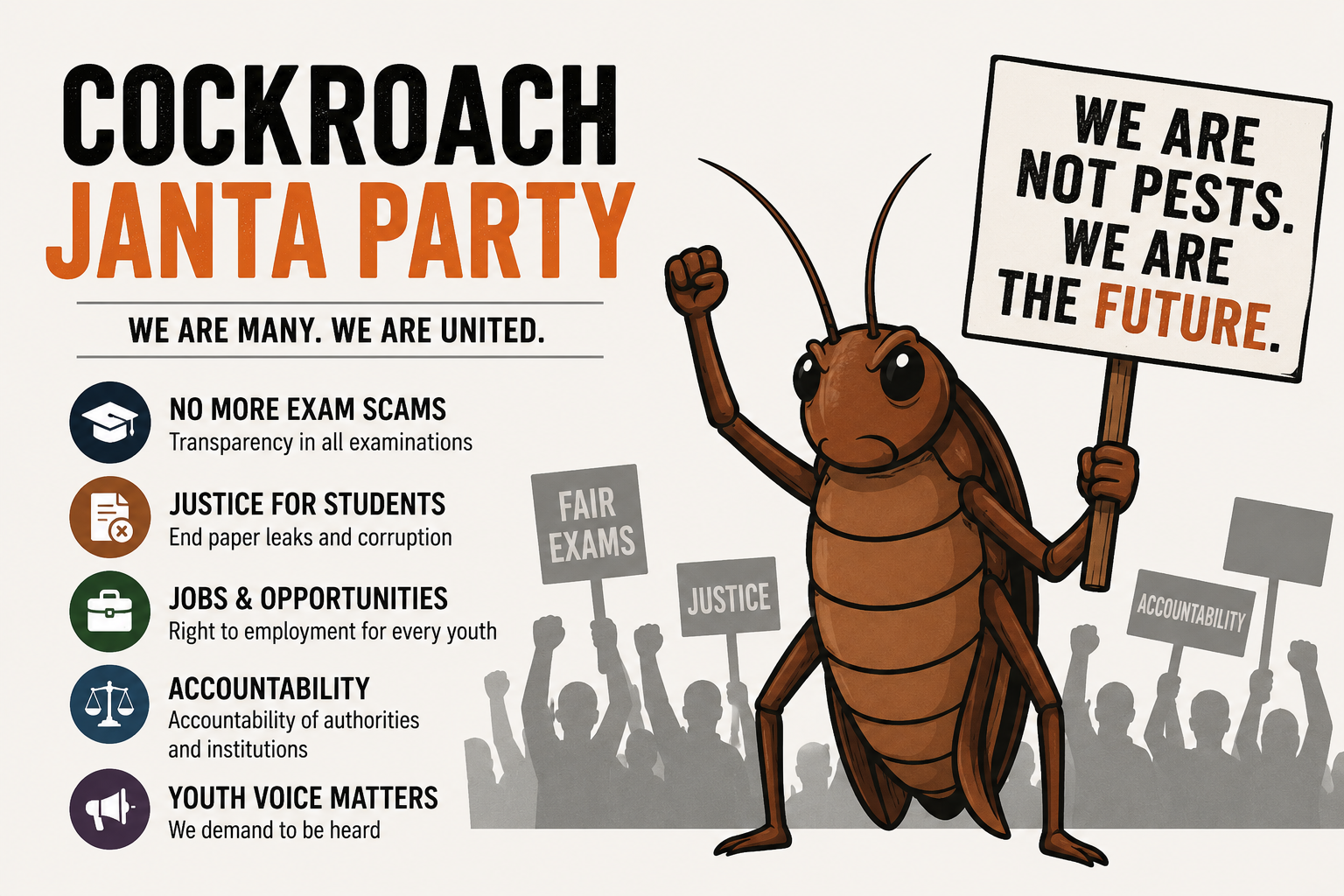
Every generation finds its own way to express anger, frustration, and demands for change. Sometimes those expressions emerge through political parties, sometimes through student movements, and sometimes through social media campaigns. In 2026, India witnessed the rise of an unusual phenomenon that began as an internet joke but quickly transformed into one of the country’s most talked-about youth movements—the Cockroach Janta Party (CJP).
What started as a satirical online response to controversial remarks about unemployed youth soon evolved into a nationwide conversation about unemployment, examination irregularities, educational failures, and the growing disconnect between young citizens and institutions. Within weeks, the movement attracted millions of followers online and eventually spilled onto the streets through organized protests. Cockroach Janta Party
The rise of the Cockroach Janta Party is significant not because it is a conventional political organization, but because it reflects a deeper social reality. It demonstrates how a generation raised on social media, burdened by competitive examinations, and struggling with employment uncertainty is increasingly willing to challenge existing systems in unconventional ways. Cockroach Janta Party
Whether the movement ultimately succeeds or fades away, it has already achieved something important—it has forced India to discuss the concerns of its youth. Cockroach Janta Party
How the Cockroach Janta Party Began
The origins of the Cockroach Janta Party are both unusual and symbolic. The movement emerged after remarks attributed to India’s Chief Justice that compared certain unemployed youth to “cockroaches” and “parasites.” The comments triggered strong reactions among many young Indians who believed they were being unfairly blamed for systemic problems beyond their control.
Instead of responding with outrage alone, a group of young people chose satire. They adopted the term “cockroach” as a badge of identity and resistance. What was initially intended as a humorous response soon resonated with a much wider audience.
The movement was founded by Abhijeet Dipke, an Indian student based in the United States, who used social media to channel growing frustration among students and young professionals. His message was simple: if young people were being dismissed as cockroaches, then perhaps it was time for the “cockroaches” to organize themselves and demand accountability.
The idea spread with remarkable speed.
Within a short period, millions of young Indians began engaging with the movement online. What made the movement unique was its ability to combine humor with serious political and social concerns. Memes, videos, satire, and protest slogans became tools for discussing issues that many young people felt were being ignored.
Why the Movement Went Viral
The success of the Cockroach Janta Party cannot be explained merely by social media algorithms. The movement became popular because it touched upon frustrations already present within Indian society.
Young Indians today face intense competition at every stage of life. Students spend years preparing for entrance examinations. Families invest enormous financial resources in coaching institutions. Career opportunities often depend upon success in a handful of competitive tests. Yet many young people feel that despite their efforts, opportunities remain limited.
Recent controversies surrounding examination systems, allegations of paper leaks, technical failures, and recruitment irregularities have further damaged public confidence. Many students believe that years of hard work can be undermined by administrative failures or corruption.
At the same time, unemployment remains a major concern for many graduates. Even individuals with degrees and professional qualifications frequently struggle to secure stable employment opportunities. Reports associated with the movement highlighted concerns regarding youth unemployment and educational outcomes.
The Cockroach Janta Party did not create these frustrations. Rather, it provided a platform through which they could be expressed.
From Social Media to Street Protests
Many online movements enjoy temporary popularity before disappearing. The true test of any social movement is whether it can translate digital engagement into real-world participation.
In June 2026, the Cockroach Janta Party took that step by organizing protests in New Delhi. Hundreds of supporters gathered at Jantar Mantar carrying placards, wearing cockroach masks, and demanding accountability for examination-related controversies. Protesters called for reforms in the education system and sought the resignation of Education Minister Dharmendra Pradhan over alleged irregularities involving examinations and recruitment processes.
The symbolism of the protest was striking. Demonstrators carried copies of the Constitution and flowers while emphasizing peaceful resistance. Organizers repeatedly stated that the movement was intended to remain non-violent and democratic.
The protests demonstrated that the movement was not merely a collection of internet memes. It had evolved into a genuine expression of youth dissatisfaction.
The Examination Crisis and Public Trust
One of the central themes of the movement has been the integrity of India’s examination system.
For millions of students, competitive examinations determine access to educational institutions, scholarships, government jobs, and professional careers. When allegations of paper leaks, administrative irregularities, or technical failures arise, the consequences extend far beyond individual examinations.
Students often spend years preparing for these tests. Parents make financial sacrifices to support coaching and educational expenses. Entire career plans may depend upon examination outcomes.
When confidence in these systems is shaken, public trust suffers.
The Cockroach Janta Party has capitalized on this concern by framing examination integrity as a matter of justice rather than merely administrative efficiency. Protesters argue that educational institutions and authorities have a duty to ensure fair opportunities for all candidates.
Regardless of one’s political views, the demand for transparency and accountability in examinations is difficult to dismiss.
The Legal Perspective
From a constitutional perspective, the movement raises important questions about democratic participation and freedom of expression.
The Indian Constitution guarantees citizens the right to freedom of speech and expression under Article 19(1)(a), subject to reasonable restrictions. Peaceful protests and public criticism of government policies generally fall within the scope of democratic participation.
The Cockroach Janta Party’s organizers have repeatedly emphasized peaceful methods, constitutional values, and non-violent protest. This approach reflects a broader tradition of democratic dissent in India.
However, constitutional rights also carry responsibilities. Public demonstrations must comply with applicable laws relating to public order and safety. Protest movements are most effective when they remain peaceful, fact-based, and focused on constructive reform.
The legal significance of the movement therefore lies not only in its demands but also in its use of constitutional methods to express dissatisfaction.
A Reflection of Generational Anxiety
Perhaps the most important aspect of the Cockroach Janta Party is what it reveals about contemporary India.
For decades, education has been presented as the primary pathway to social mobility. Young people were encouraged to believe that hard work, academic achievement, and professional qualifications would lead to economic security and career success.
Many young Indians continue to embrace these values. However, increasing competition, economic uncertainty, and concerns about institutional credibility have created anxiety about whether the traditional formula still works.
The movement reflects fears that opportunities are becoming harder to access despite greater educational attainment. It reflects concerns that success increasingly depends upon factors beyond individual effort. Most importantly, it reflects a desire to be heard.
The popularity of the movement suggests that many young people feel disconnected from institutions that are supposed to represent their interests.
Criticism and Skepticism
Like any social movement, the Cockroach Janta Party has attracted criticism.
Some observers argue that the movement relies too heavily on symbolism and social media popularity. Others question whether it possesses a coherent long-term agenda beyond criticism of existing systems.
Critics have also suggested that internet popularity does not necessarily translate into meaningful political change. History contains many examples of viral movements that attracted attention but failed to produce lasting reforms.
These criticisms are not entirely without merit. Sustaining momentum beyond social media is challenging. Converting public frustration into policy reform requires organization, leadership, and clear objectives.
The future of the movement will depend largely on whether it can evolve from protest into constructive advocacy.
What the Movement Means for India
The rise of the Cockroach Janta Party should not be viewed solely through a political lens. It is equally a social and institutional phenomenon.
Its emergence highlights growing concerns about unemployment, educational governance, examination integrity, and youth representation. It demonstrates the power of digital platforms to mobilize large numbers of people around shared grievances.
More importantly, it sends a message to policymakers, educational institutions, and regulators that public confidence cannot be taken for granted.
Young citizens are increasingly informed, connected, and willing to challenge systems they perceive as unfair. They are also increasingly creative in the methods they use to express dissent.
The movement illustrates that modern political engagement often begins not in traditional party offices but on smartphones, social media platforms, and digital communities.
Conclusion
The Cockroach Janta Party may have begun as a joke, but the issues it highlights are anything but humorous. Beneath the memes, masks, and satire lies a serious conversation about the future of India’s youth.
The movement has emerged at a time when millions of young Indians are questioning the reliability of educational systems, the availability of employment opportunities, and the responsiveness of public institutions. By transforming a perceived insult into a symbol of collective identity, its supporters have demonstrated how quickly frustration can evolve into organized activism.
Whether the Cockroach Janta Party becomes a lasting force or a temporary moment in India’s political history remains uncertain. What is certain, however, is that it has exposed a growing gap between institutional narratives and the lived experiences of many young people.
Movements come and go. The underlying concerns that create them often remain.
If policymakers, educational authorities, and public institutions choose to listen, the Cockroach Janta Party may ultimately be remembered not as a meme movement, but as a warning sign that a generation was demanding to be heard.
Author: Dhanwanti Rai, Advocate
This article is intended for educational and informational purposes only and does not constitute legal advice.
https://advawanti.com/wp-admin/post.php?post=5335&action=edit