Introduction
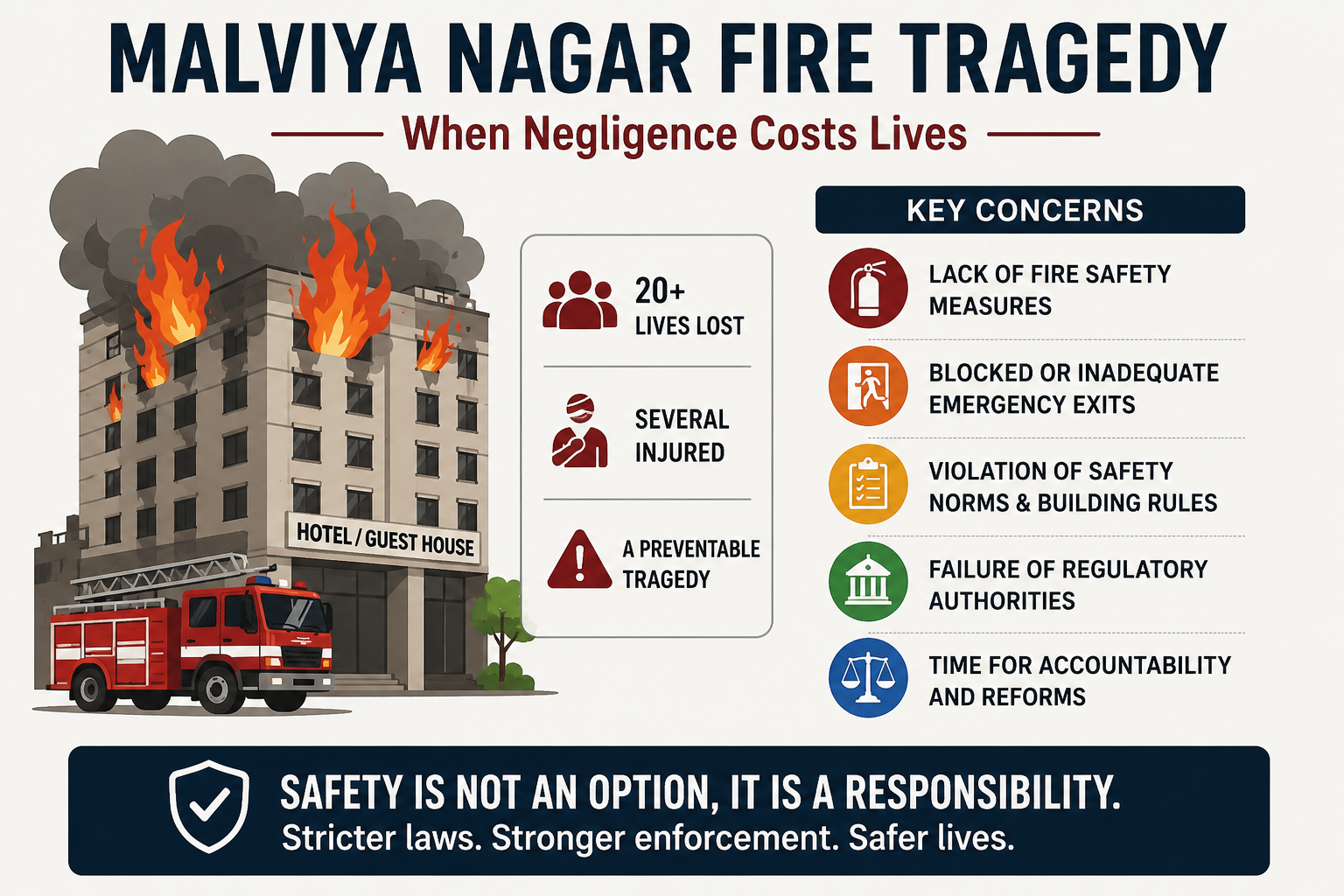
Malviya Nagar Fire Tragedy: The tragic fire that broke out in a hotel and guest house complex in Delhi’s Malviya Nagar area has once again exposed a harsh reality that India continues to ignore until disaster strikes. Reports indicate that more than twenty people lost their lives, while several others sustained injuries after being trapped inside the building during the fire. Many victims reportedly jumped from windows and balconies in a desperate attempt to save themselves as smoke and flames rapidly engulfed the premises. Malviya Nagar Fire Tragedy
The incident has shocked the nation not only because of the scale of human loss but also because of the disturbing allegations that have emerged during the preliminary investigation. Questions are being raised about fire safety compliance, emergency preparedness, building permissions, occupancy limits, evacuation mechanisms, and the responsibility of authorities entrusted with ensuring public safety. Malviya Nagar Fire Tragedy
While the immediate focus understandably remains on rescue operations and support for affected families, this tragedy also demands a deeper examination of the legal responsibilities of hotel owners, municipal authorities, licensing agencies, and fire safety regulators. The Malviya Nagar fire is not merely an accident; it is a reminder that when safety regulations exist only on paper, lives are placed at risk. Malviya Nagar Fire Tragedy
The incident has reignited an important debate about accountability in India. Who is responsible when a preventable tragedy claims innocent lives? Can such incidents be dismissed as accidents, or do they constitute criminal negligence? Most importantly, what lessons must be learned to ensure that similar disasters do not occur again? Malviya Nagar Fire Tragedy
The Incident and the Human Cost
According to reports, the fire broke out during the early hours when many occupants were asleep. As flames spread through the building, panic quickly followed. Guests found themselves trapped inside rooms filled with thick smoke. Emergency exits were reportedly difficult to access, and several victims were forced to make split-second decisions between remaining inside a burning structure and attempting dangerous escapes through windows. Malviya Nagar Fire Tragedy
Eyewitness accounts paint a horrifying picture of confusion, fear, and desperation. Families were separated. People screamed for help from upper floors. Rescue personnel struggled to reach individuals trapped inside smoke-filled corridors. Survivors have described moments where visibility was nearly impossible and breathing became increasingly difficult due to toxic fumes. Malviya Nagar Fire Tragedy
In fire incidents, smoke inhalation often proves more deadly than the flames themselves. Many victims lose consciousness before they can locate exits. This is precisely why fire safety regulations require functioning alarm systems, smoke detectors, emergency lighting, evacuation routes, and trained personnel capable of assisting occupants during emergencies. Malviya Nagar Fire Tragedy
Every life lost in such incidents represents more than a statistic. Behind each number is a family that has lost a parent, spouse, child, sibling, or friend. The tragedy therefore demands not only sympathy but accountability. Malviya Nagar Fire Tragedy
Why Fire Safety Rules Exist
Many building owners view fire safety requirements as bureaucratic formalities that complicate business operations. However, every fire safety regulation has emerged from past tragedies and lessons learned through loss of life. Malviya Nagar Fire Tragedy
Fire safety norms are designed to address three critical objectives. First, they aim to prevent fires from occurring. Second, they seek to detect fires at the earliest possible stage. Third, they facilitate safe evacuation and rescue if a fire does occur. Malviya Nagar Fire Tragedy
Hotels and guest houses are considered particularly sensitive establishments because they accommodate people who may be unfamiliar with the building layout. Unlike residents who know the location of exits and staircases, guests often rely entirely on visible signage and emergency guidance during crises. Malviya Nagar Fire Tragedy
When fire extinguishers are missing, alarms do not function, exits are blocked, or occupancy limits are exceeded, the consequences can be catastrophic. What begins as a manageable incident can rapidly escalate into a mass casualty event. Malviya Nagar Fire Tragedy
The Malviya Nagar tragedy highlights the devastating consequences that can arise when fire safety systems fail or are inadequately implemented. Malviya Nagar Fire Tragedy
The Legal Responsibility of Hotel Owners
Under Indian law, hotel owners and operators owe a significant duty of care to their guests. When individuals pay for accommodation, they are entitled to expect that the premises are reasonably safe and comply with applicable legal standards. Malviya Nagar Fire Tragedy
This duty extends beyond providing clean rooms and basic amenities. It includes ensuring structural safety, maintaining emergency equipment, complying with fire regulations, conducting inspections, and training staff to respond effectively during emergencies. Malviya Nagar Fire Tragedy
If investigations reveal that mandatory safety measures were absent, defective, or deliberately ignored, hotel management could face serious legal consequences. Authorities may examine whether the establishment possessed valid licenses, whether fire safety certificates were current, and whether occupancy exceeded approved limits. Malviya Nagar Fire Tragedy
The law generally imposes higher responsibilities on businesses that invite members of the public onto their premises. Hotels profit from providing accommodation and therefore bear corresponding obligations to protect guests from foreseeable risks. Malviya Nagar Fire Tragedy
A fire in a hotel is not always evidence of negligence. However, a failure to maintain required safety measures can transform an unfortunate incident into a case of legal liability. Malviya Nagar Fire Tragedy
Criminal Negligence and Potential Liability
One of the most important legal questions arising from the Malviya Nagar fire concerns criminal negligence. Indian criminal law recognizes that individuals may be held accountable when reckless or negligent conduct results in death or injury. Malviya Nagar Fire Tragedy
Criminal negligence differs from a mere mistake. It generally involves conduct demonstrating a disregard for safety standards that a reasonable person would have followed under similar circumstances. If an owner knowingly ignores fire safety requirements, continues operations despite serious deficiencies, or allows dangerous conditions to persist, authorities may consider whether criminal liability arises. Malviya Nagar Fire Tragedy
Investigators are likely to examine several critical issues. Were fire exits blocked? Were fire alarms operational? Were extinguishers maintained? Had previous warnings or notices been issued by authorities? Did management knowingly permit unsafe conditions to continue? Malviya Nagar Fire Tragedy
has raised significant concerns regarding the implications of negligence in safety management. The incident serves as a stark reminder of the need for stringent adherence to safety protocols, as failure to comply can lead to catastrophic outcomes. Legal authorities must thoroughly investigate the circumstances surrounding the tragedy to ascertain accountability and prevent future occurrences. Ultimately, the findings may catalyze reforms in regulatory practices and reinforce the imperative for vigilant oversight in fire safety standards.
The Role of Municipal Authorities
Whenever a major fire occurs, attention naturally focuses on the property owner. However, responsibility may not end there. Malviya Nagar Fire Tragedy
Municipal authorities play a crucial role in regulating buildings, granting permissions, monitoring compliance, and enforcing safety standards. Questions often arise regarding whether inspections were conducted, whether violations were identified, and whether corrective measures were implemented.
If authorities had previously detected irregularities but failed to take meaningful action, concerns about administrative accountability may emerge. Public safety depends not only on regulations but also on effective enforcement.
In many cases, safety violations continue for years because enforcement mechanisms are weak or inconsistent. Buildings may obtain initial approvals but subsequently undergo unauthorized modifications that compromise safety. Additional rooms may be constructed, exits may be obstructed, and occupancy limits may be exceeded without adequate oversight.
The Malviya Nagar tragedy serves as a reminder that regulatory systems are effective only when they are actively enforced.
Fire Department Oversight and Compliance
Fire departments perform an essential preventive function. Their responsibilities often include inspections, issuance of fire safety clearances, verification of compliance, and recommendations for corrective action.
Following a major fire incident, investigators frequently review inspection records and certification documents. If deficiencies existed, authorities may seek to determine whether they were identified during inspections and whether adequate follow-up action occurred.
This process is not intended to assign blame indiscriminately. Rather, it seeks to identify systemic failures that may have contributed to the tragedy. Effective accountability requires understanding not only how the fire started but also why existing safeguards failed to prevent loss of life.
Victims and their families may have grounds to pursue compensation where negligence contributed to injuries or deaths. Compensation claims can arise through various legal mechanisms depending on the facts of the case and the findings of investigations.
Rights of Victims and Their Families
Families affected by such disasters often focus initially on grief and recovery. However, legal remedies may also become relevant.
Courts frequently consider factors such as the nature of negligence, the extent of injuries, loss of income, medical expenses, future financial dependency, and emotional suffering. In cases involving multiple victims, authorities sometimes establish compensation frameworks to provide immediate financial assistance while legal proceedings continue.
Compensation, however, can never fully address the loss of human life. Its purpose is to provide some measure of support and accountability rather than replace what has been lost.
The Broader Problem of Fire Safety in India
The Malviya Nagar incident is not an isolated event. India has witnessed numerous fire tragedies in hospitals, coaching centers, factories, commercial buildings, schools, and residential complexes. Each incident generates public outrage, investigations, and promises of reform. Yet similar disasters continue to occur.
A recurring pattern often emerges. Safety norms exist. Violations are identified. Enforcement remains inconsistent. Eventually, a tragedy exposes vulnerabilities that had been ignored for years.
This cycle demonstrates that fire safety cannot be treated as a reactive exercise. Compliance inspections conducted only after disasters are insufficient. Prevention must become a continuous priority.
Building owners, administrators, regulators, and occupants all share responsibility for maintaining safe environments. Public awareness is equally important because individuals who recognize safety deficiencies are more likely to demand corrective action before disasters occur.
Lessons for Travelers and Long-Term Guests
The tragedy also offers important lessons for travelers. Many people choose accommodations based primarily on price, location, or convenience. Fire safety rarely influences booking decisions despite its critical importance.
Guests should consider checking whether emergency exits are visible, whether smoke detectors are present, and whether evacuation instructions are displayed. In larger hotels, familiarity with escape routes can prove invaluable during emergencies.
For individuals requiring extended stays, particularly those undergoing long-term medical treatment in another city, alternatives such as serviced apartments or well-regulated rental accommodations may offer additional advantages. Such arrangements often provide more living space, kitchen facilities, and greater familiarity with the environment. Regardless of the accommodation selected, safety should remain a primary consideration.
The Need for Stronger Enforcement
The Malviya Nagar fire demonstrates that regulations alone cannot prevent disasters. Laws, inspections, certifications, and compliance requirements are meaningful only when implemented consistently and rigorously.
Technology can play a significant role in improving enforcement. Digital inspection records, publicly accessible compliance databases, real-time monitoring systems, and periodic audits could enhance transparency and accountability. Citizens should be able to verify whether establishments possess valid safety certifications before choosing to visit or stay there.
Stronger penalties for repeated violations may also encourage greater compliance. Businesses that profit from public occupancy must recognize that safety obligations are not optional administrative burdens but essential responsibilities.
Conclusion
The Malviya Nagar fire tragedy is a painful reminder of the consequences of neglecting safety standards. While investigators will ultimately determine the precise causes and identify those responsible, the broader lesson is already clear. Fire safety is not merely a regulatory requirement; it is a matter of life and death.
Every guest who enters a hotel, every patient admitted to a hospital, every student attending a coaching center, and every employee working in a commercial building places trust in those responsible for maintaining safe premises. When that trust is betrayed through negligence, the consequences can be irreversible.
The true measure of accountability will not be found solely in criminal cases, compensation claims, or official reports. It will be found in whether this tragedy leads to meaningful reforms that prevent future loss of life. If lessons are ignored and safety remains secondary to profit or convenience, similar incidents will continue to occur.
The victims of the Malviya Nagar fire deserve more than condolences. They deserve a commitment from society, regulators, and institutions that their deaths will serve as a catalyst for stronger safety standards, stricter enforcement, and a culture in which human life is valued above all else.
Author: Dhanwanti Rai, Advocate
This article is intended for informational and educational purposes and does not constitute legal advice.
https://advawanti.com/wp-admin/post.php?post=5335&action=edit