Lessons from the Samay Raina Case In recent times, online content creators, including personalities like Samay Raina, have increasingly found themselves facing criminal complaints and FIRs over content perceived as offensive or controversial. With the rapid growth of digital platforms and the widespread reach of social media, even satirical, comedic, or opinion-based content is being subjected to heightened scrutiny.
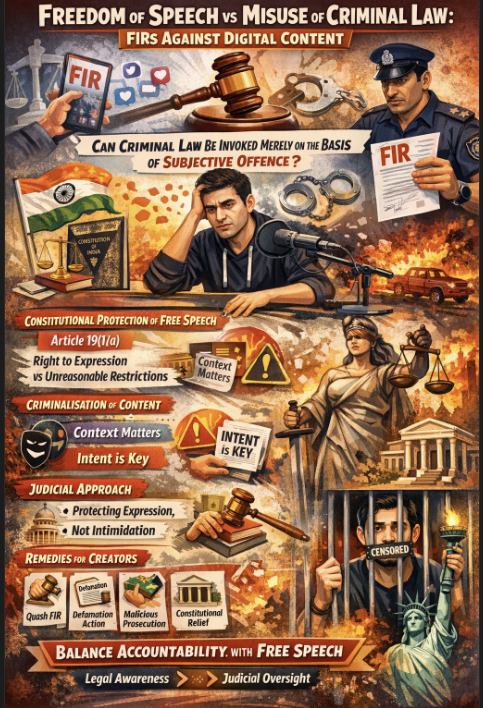
This trend reflects a growing tendency to invoke criminal law in response to subjective interpretations of offence, often without a clear examination of the legal thresholds required to sustain such allegations. As a result, creators are not only navigating public opinion but are also being drawn into legal battles, raising important concerns about the balance between freedom of expression and the misuse of criminal processes in a digital society.Lessons from the Samay Raina Case
This raises a crucial legal question:
Can criminal law be legitimately invoked merely on the basis of subjective offence or personal disagreement?
In a diverse and pluralistic society like India, where opinions, beliefs, and sensitivities vary widely, the threshold for initiating criminal action cannot be reduced to individual perceptions of discomfort or dissent. The law requires a higher standard—one that is grounded in objective legal principles, demonstrable harm, and clearly defined statutory provisions.
Treating every instance of perceived offence as a criminal matter not only risks diluting the seriousness of penal law but also opens the door to its misuse as a tool for suppression, rather than protection. This makes it imperative to carefully examine whether such legal actions truly meet the established criteria under criminal jurisprudence. Lessons from the Samay Raina Case
1. Constitutional Protection of Free Speech: Lessons from the Samay Raina Case
The Constitution of India guarantees the fundamental right to freedom of speech and expression under Article 19(1)(a). This right forms the cornerstone of a democratic society, enabling individuals to express ideas, opinions, and dissent without undue interference. Its scope is broad and encompasses not only formal or serious discourse but also creative expressions, satire, humour, and artistic freedom.
Over time, judicial interpretation has reinforced that this freedom is essential for the functioning of an open society, where diverse viewpoints can coexist and public dialogue can thrive. Importantly, the protection extends even to expressions that may be unpopular, provocative, or unsettling, as long as they do not transgress the legally defined boundaries. Lessons from the Samay Raina Case
However, this freedom is not absolute and is subject to reasonable restrictions under Article 19(2). These restrictions permit the State to impose limitations in the interests of, among other things, public order, decency, morality, defamation, and incitement to an offence.
Importantly, such restrictions are not meant to be invoked casually or on the basis of mere disagreement or subjective offence. The limitation must satisfy the test of reasonableness, have a proximate nexus with the grounds specified in law, and meet the threshold of actual or potential harm as recognized in criminal jurisprudence. Lessons from the Samay Raina Case Lessons from the Samay Raina Case
Courts have consistently emphasized that any restriction on speech must be narrowly tailored and proportionate, ensuring that the fundamental right under Article 19(1)(a) is not rendered illusory by overbroad or arbitrary application of these exceptions. Lessons from the Samay Raina Case
Importantly, mere hurt sentiments or personal disagreement do not automatically fall within these restrictions unless accompanied by clearly established legal thresholds. The law requires more than a subjective reaction—it demands a demonstrable connection to one of the grounds specified under Article 19(2), supported by evidence of real or imminent harm.
Courts have repeatedly underscored that the standard to restrict speech cannot be that of a hypersensitive or easily offended individual, but of a reasonable person placed in similar circumstances. In the absence of such objective criteria, invoking criminal law risks converting personal sensitivities into legal violations, thereby undermining the constitutional guarantee of free expression.ar legal thresholds. Lessons from the Samay Raina Case
2. Criminalisation of Content: Where is the Line?
For an FIR to sustain in law, the alleged act must clearly satisfy the essential ingredients of a specific penal provision. A mere allegation or expression of grievance is not sufficient; the complaint must disclose a cognizable offence on the face of it and demonstrate how the conduct complained of squarely falls within the statutory framework.
In the context of online content, complaints are often sought to be brought under provisions relating to obscenity, defamation, or public mischief. However, the invocation of such provisions requires a careful and contextual analysis of the content in question—its intent, its overall message, and its potential impact on society. Lessons from the Samay Raina Case
Crucially, isolated excerpts or selective interpretation cannot form the sole basis of criminal liability. The content must be assessed in its entirety, and there must be a clear indication of harm or tendency to disrupt public order, lower reputation as defined under Indian Penal Code Section 499, or otherwise meet the strict legal thresholds prescribed under criminal law. Lessons from the Samay Raina Case
However, courts have consistently held that:
- The content must be assessed in its entirety and context, not in isolated parts. A fragmented or selective reading of any expression—especially in the realm of digital content, satire, or humour—can lead to a distorted understanding of its true meaning and intent. Courts have consistently cautioned against picking out stray sentences or clips divorced from their surrounding context, as this approach risks attributing a meaning that the creator never intended to convey.
- In evaluating whether any content crosses the threshold of illegality, it is essential to consider the overall narrative, tone, purpose, and the audience it is directed towards. A holistic assessment ensures that the legal analysis remains fair, objective, and aligned with established principles of criminal jurisprudence, rather than being influenced by selective outrage or subjective interpretation. Lessons from the Samay Raina Case
- There must be a clear intent or a proximate tendency to cause public disorder or harm. Criminal liability cannot be fastened in the absence of a demonstrable link between the expression and its potential to disrupt public order or adversely affect society at large. Mere speculation, remote possibilities, or exaggerated apprehensions are insufficient to justify the invocation of penal provisions.
- The law requires that the alleged act should have a direct and reasonable nexus with the anticipated harm, and not be based on far-fetched or hypothetical consequences. This ensures that criminal law is applied only in situations where there is a genuine risk to societal interests, rather than being used to penalize expressions that are simply unpopular, provocative, or misunderstood. Lessons from the Samay Raina Case
- A reasonable person standard must be applied—not a hypersensitive reaction. The assessment of whether any content is objectionable or unlawful must be based on how an ordinary, prudent individual, placed in similar circumstances, would perceive it, rather than the reaction of someone who is unduly sensitive or predisposed to take offence.
- This objective standard acts as a safeguard against arbitrary or excessive application of criminal law, ensuring that liability is not triggered by extreme or subjective interpretations. By grounding the analysis in reasonableness, the law seeks to balance competing interests—protecting societal harmony while preserving the fundamental right to free expression.
3. Judicial Approach: Protecting Expression
Indian courts, including the Supreme Court, have repeatedly emphasized that the right to freedom of expression is not confined to polite, agreeable, or widely accepted views, but extends equally to expressions that challenge, critique, dissent, and even offend. The jurisprudence surrounding Article 19(1)(a) has consistently recognized that in a democratic society, the true test of this freedom lies in protecting unpopular or controversial speech, so long as it does not transgress into the narrowly defined restrictions under Article 19(2).
The Supreme Court has underscored that open dialogue, debate, and the ability to question prevailing norms are essential for societal progress, and these cannot be curtailed merely because a section of society finds the expression disagreeable or offensive. At the same time, the Court has maintained that such protection is not absolute, and any expression that has a clear tendency to incite violence, disrupt public order, or infringe upon the rights and reputation of others may legitimately invite legal consequences.
Thus, the judicial approach seeks to strike a careful balance—ensuring that freedom of expression remains robust and meaningful, while preventing its misuse in a manner that causes tangible harm. This balance is critical to preserving both individual liberty and the larger public interest in a constitutional democracy..
The tendency to file FIRs for content that is merely unpopular or provocative risks:
- The increasing tendency to initiate criminal proceedings over controversial or unpopular expression has a significant chilling effect on free speech. When individuals are exposed to the constant threat of FIRs, legal harassment, or prolonged litigation, they may begin to self-censor—not because their expression is unlawful, but out of fear of potential consequences.
- This environment discourages open dialogue, creative expression, and critical thinking, which are essential to a healthy democracy. Over time, such a chilling effect can narrow the scope of public discourse, where only “safe” or conformist views are expressed, thereby undermining the very essence of the freedom guaranteed under Article 19(1)(a).
- The indiscriminate filing of complaints and FIRs in matters involving subjective offence also contributes to overburdening the criminal justice system. Law enforcement agencies and courts are required to allocate time and resources to cases that may lack substantive legal merit, thereby diverting attention from serious offences that genuinely threaten public safety and order.
- Such misuse not only delays justice for deserving cases but also strains an already burdened system, leading to inefficiency and backlog. It underscores the need for a more responsible invocation of criminal law, ensuring that it is reserved for situations where clear legal violations and tangible harm are evident, rather than being employed as a response to personal disagreement or public outrage.
- The growing tendency to invoke criminal law in response to disagreement or offence also risks encouraging the misuse of legal processes as tools of intimidation. When complaints and FIRs are initiated without a strong legal foundation, they can serve less as instruments of justice and more as mechanisms to pressure, silence, or harass individuals.
- Such practices undermine the integrity of the legal system, as the process itself becomes the punishment—forcing individuals to engage in prolonged legal battles, incur costs, and face reputational harm, irrespective of the eventual outcome. This not only erodes public confidence in the justice delivery system but also creates a precedent where the law is used strategically to stifle expression rather than to address genuine legal wrongs.
4. Remedies Available to Content Creators
Where an FIR is filed without a sustainable legal basis, the aggrieved party has several remedies:
- An aggrieved person may approach the High Court seeking quashing of an FIR under its inherent powers (traditionally under Section 482 CrPC, now reflected in the corresponding provisions under the Bharatiya Nagarik Suraksha Sanhita). This jurisdiction is exercised to prevent abuse of the legal process and to secure the ends of justice. Where the FIR, on the face of it, fails to disclose any cognizable offence or appears to be frivolous, malicious, or legally unsustainable, the High Court can intervene at an early stage and set aside the proceedings, thereby protecting individuals from unwarranted criminal prosecution.
- Another remedy available in such situations is the initiation of defamation proceedings under Indian Penal Code Section 499, where false statements or imputations are made that harm an individual’s reputation. If it can be shown that the allegations were not only incorrect but were made with the intent to damage reputation or with knowledge of their falsity, the aggrieved party may seek appropriate legal action.
- Defamation law thus acts as a safeguard against reputational harm, ensuring that while freedom of speech is protected, it does not extend to the dissemination of false and damaging assertions against any individual.
- Another potential remedy lies in initiating an action for malicious prosecution, where legal proceedings are instituted with improper intent and without reasonable or probable cause. To succeed in such a claim, the aggrieved party must demonstrate that the proceedings were initiated maliciously, lacked a valid legal foundation, and were ultimately decided in their favour.
- This remedy serves as a check against the abuse of legal processes, ensuring that individuals who are subjected to baseless and motivated litigation have recourse to seek compensation for the harm, harassment, and reputational damage suffered as a result.
- In appropriate cases, an aggrieved person may also invoke constitutional remedies where the initiation of criminal proceedings results in a violation of fundamental rights. The right to approach the High Courts under Article 226 and the Supreme Court under Article 32 of the Constitution serves as a vital safeguard against arbitrary state action.
- Where it can be demonstrated that the action of registering or pursuing an FIR infringes the fundamental right to freedom of speech and expression under Article 19(1)(a), or is otherwise unconstitutional, the constitutional courts have the power to grant appropriate relief, including quashing of proceedings, protection of liberty, and enforcement of fundamental rights.
5. Conclusion: The Need for Legal Balance
While accountability in digital spaces is undoubtedly necessary to maintain order and responsibility, criminal law cannot be reduced to a tool for enforcing personal sensitivities or subjective discomfort. The purpose of penal provisions is to address genuine legal wrongs that cause tangible harm to individuals or society, not to police individual opinions or reactions.
Allowing criminal law to be invoked on the basis of personal offence risks diluting its seriousness and opens the door to arbitrary and inconsistent application. A balanced approach is therefore essential—one that ensures accountability where legally warranted, while firmly safeguarding the constitutional guarantee of free expression under Article 19(1)(a).
A mature legal system must strike a balance—
protecting individuals from genuine harm, while also safeguarding the foundational right to free expression.
The increasing trend of initiating criminal proceedings against creators for subjective offence underscores the urgent need for greater legal awareness, heightened judicial scrutiny, and a more responsible invocation of criminal law. In a digital ecosystem where content is rapidly produced and widely consumed, there is a growing risk of conflating personal disagreement or emotional reactions with actionable legal wrongs.
It becomes essential, therefore, to reinforce the understanding that criminal law is a precise instrument meant for addressing clearly defined offences, not a reactionary tool for settling subjective grievances. Strengthening legal literacy among the public, coupled with careful judicial intervention at appropriate stages, is crucial to ensure that the criminal justice system is not misused and that the constitutional balance between accountability and freedom of expression under Article 19(1)(a) is preserved.
Understanding the limits of law is as important as understanding one’s rights under Article 19(1)(a). A well-functioning legal system is built not only on the enforcement of rights but also on the responsible exercise of legal remedies. When criminal law is invoked beyond its intended scope, it not only places undue burden on individuals but also risks weakening the integrity and efficiency of the justice system as a whole.
Therefore, a balanced and informed approach is essential—one that respects constitutional freedoms while ensuring that legal processes are not misused for addressing subjective grievances or personal disagreements.
https://www.youtube.com/channel/UCNiunNYsjR0ThOMfg11H0mA
https://advawanti.com/wp-admin/post.php?post=5256&action=edit